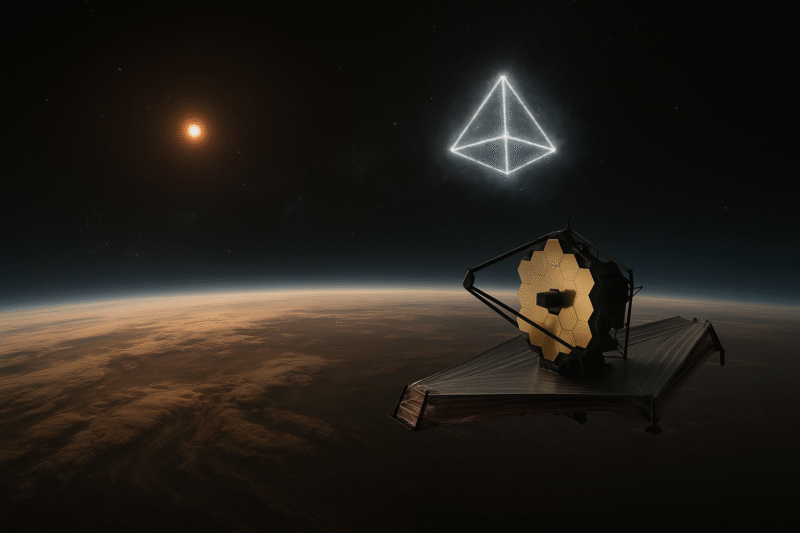







The universe is a vast, restless sea of celestial bodies, many of which silently wander through space with little regard for human affairs. But sometimes, one of these wandering rocks draws attention and concern. Asteroid 2024 YR4 is one such object. Discovered on December 27, 2024, this near-Earth asteroid of the Apollo group rapidly became the focus of international attention due to its unpredictable orbit and unsettling proximity to both Earth and the Moon.
Table of Contents
Early calculations suggested a slight chance of impact with Earth, triggering temporary fears of a worst-case planetary collision scenario. However, refined data from observatories and NASA’s James Webb Space Telescope helped reduce that fear to nearly zero. Instead, a new concern emerged, what if 2024 YR4 were to strike the Moon?
While our planet may be spared, scientists have now calculated a non-trivial 3.8% chance that the asteroid could slam into the lunar surface on or around December 22, 2032. If it does, this wouldn’t just be a bright spectacle in the night sky. It could change the way we approach lunar exploration, orbital infrastructure, and interplanetary defense, possibly forever.
A Cosmic Bullet: Understanding the Threat from 2024 YR4
To comprehend the magnitude of this scenario, we must first understand the properties of 2024 YR4. Measuring approximately 60 meters (or roughly 197 feet) across, this asteroid is categorized as a “city-killer” large enough to wipe out a major urban center if it ever struck Earth. Now, shift that threat to the Moon, where no atmosphere exists to break up the object and slow it down. At an estimated impact velocity of 13.9 kilometers per second (about 31,000 mph), 2024 YR4 could deliver an enormous kinetic punch to the lunar surface.
The impact would likely create a new crater measuring between 500 and 2,000 meters wide, depending on lunar surface composition. This explosion would release energy orders of magnitude greater than previous recorded impacts, potentially outshining the full Moon for a brief moment in time and being visible to the naked eye from Earth. For observers, it would be a rare astronomical light show. But for engineers, astronomers, and future space settlers, it could signal a cascade of consequences.
We’ve seen smaller meteoroids hit the Moon before and they’ve produced craters visible from Earth and explosions bright enough to be seen without telescopes. One such case involved a boulder-sized rock creating an impact equivalent to 5 tons of TNT. Now imagine an object over 100 times more massive striking at a similar or greater speed.
Debris Fallout and the Threat to Earth’s Infrastructure in Space
The Moon may be lifeless, but it is not without strategic significance. In the 21st century, it represents a gateway to deep space, a test-bed for colonization, and a platform for scientific discovery. Should asteroid 2024 YR4 hit the lunar surface, the explosion would eject millions of tons of debris. Some of this debris would remain in lunar orbit, forming a dangerous cloud of high-velocity fragments. Others would escape the Moon’s gravity entirely entering cislunar space, and eventually Earth orbit.
Now consider the technological ecosystem we’ve constructed in low Earth orbit (LEO). Satellites, GPS arrays, communication systems, and even the upcoming generation of private space stations such as Vast’s Haven-1 could all be at risk. These delicate instruments are not designed to withstand even tiny high-speed collisions. A paint fleck traveling at orbital speeds can do serious damage. A 1-centimeter fragment could release the equivalent energy of a 550-pound object hitting Earth at 90 km/h. A 10-centimeter piece? That’s equivalent to 7 kilograms of TNT.
In a worst-case scenario, the resulting shower of debris from a lunar impact could initiate a chain reaction in LEO a Kessler Syndrome where collisions between orbiting objects produce more fragments, leading to an exponential cascade of destruction. The consequences would be dire: GPS disruption, global communications outages, collapsed weather forecasting systems, and a multiyear inability to safely launch new satellites. Our global economy, increasingly reliant on space infrastructure, could enter a tailspin.
The Lunar Minefield: Obstacles to a Permanent Human Presence on the Moon
2024 YR4’s potential impact also jeopardizes another grand ambition, human colonization of the Moon. For decades, space agencies have dreamed of establishing a sustained lunar presence. With Artemis missions underway and private companies pushing toward space tourism and lunar exploration, this dream edges closer to reality.
But a lunar impact of this scale could delay or derail these efforts. The debris ejected from the Moon that remains trapped in its orbit could linger for years, forming a deadly minefield around the Moon itself. Any spacecraft attempting to land, orbit, or launch from the Moon would have to navigate this debris field, increasing costs and risks exponentially.
And that’s not all. Some of the ejecta would not remain in stable orbit. Over time, it would fall back to the lunar surface sometimes months or years later. If humans establish habitats on the Moon, this “delayed bombardment” could pose a continual, unpredictable threat to surface installations and colonists. Picture living under constant threat from meteorite showers with no atmosphere to shield you. The risk isn’t hypothetical it’s measurable, predictable, and entirely preventable.
Can We Prevent the Impact? The Case for Planetary Defense
Here’s the most sobering reality: we have the tools to prevent all of this today. Unlike apocalyptic asteroid scenarios portrayed in Hollywood films, a collision with the Moon is not inevitable. Experts suggest that a modest deflection mission could nudge 2024 YR4 off course. We wouldn’t need to develop new spacecraft or technologies. We could use existing platforms like the NASA Orion spacecraft or ESA’s European Service Module to mount a co-manifested mission one that hitches a ride on already-planned launches and delivers a kinetic impactor or gravity tractor to alter YR4’s path just enough.
It’s a matter of will, not capability. Unfortunately, with public discourse focused more on the light show than the long-term ramifications, this critical mission lacks the urgency it deserves. A strategic deflection now could prevent an orbital crisis, protect billion-dollar infrastructure, and keep humanity’s lunar ambitions on track.
A Cosmic Warning Shot — And a Call to Action
Asteroid 2024 YR4 presents us with a unique crossroads in space history. We stand at the precipice of a potential lunar event that could either mark the next great chapter in astronomical discovery — or the opening act of a preventable disaster. Whether this asteroid hits the Moon or not, it serves as a clarion call for spacefaring nations: we must evolve from passive observers of cosmic events to active stewards of our celestial environment.
The technologies exist. The knowledge is there. What remains to be seen is whether humanity has the foresight to act. The Moon is not merely a distant rock; it is our staging ground for interplanetary exploration. Let us not allow shortsightedness to undermine our future among the stars.
Asteroid 2024 YR4 FAQ’s
What is asteroid 2024 YR4?
Asteroid 2024 YR4 is a near-Earth object (NEO) classified as part of the Apollo group of asteroids. Discovered in December 2024, it measures approximately 60 meters in diameter and was initially thought to pose a minor threat to Earth. However, recent analyses now suggest a small but significant chance of it impacting the Moon in 2032.
What if asteroid 2024 YR4 hits the Moon?
If asteroid 2024 YR4 hits the Moon, it could create a crater between 500 and 2,000 meters in diameter and release energy far greater than any lunar impact observed in modern times. This would eject massive debris into space, potentially endangering satellites, the International Space Station’s successors, and future lunar bases.
How likely is a Moon collision with asteroid 2024 YR4?
Current estimates place the probability at around 3.8% for an impact on or around December 22, 2032. While low, this probability is significant enough for astronomers and space agencies to take the potential impact seriously and consider deflection strategies.
Could an asteroid hitting the Moon affect Earth?
While asteroid 2024 YR4 will not directly impact Earth, debris from a Moon collision could enter Earth’s orbit, posing a threat to satellites and orbital infrastructure. It could also trigger a Kessler Syndrome-like scenario, where collisions in low Earth orbit create a cascading cloud of debris.
What are the dangers of lunar debris to satellites?
Lunar debris, even small particles, can travel at speeds of tens of thousands of kilometers per hour. A 1-centimeter fragment could cause catastrophic damage to satellites or spacecraft. If 2024 YR4 hits the Moon, the resulting debris could overwhelm low Earth orbit, damaging or destroying communication and GPS systems.
Sources
- NASA Science – Update on the Size Estimate and Lunar Impact Probability of Asteroid 2024 YR4: https://science.nasa.gov/blogs/planetary-defense/2025/04/02/nasa-update-on-the-size-estimate-and-lunar-impact-probability-of-asteroid-2024-yr4
- NASA Science – Asteroid 2024 YR4 Page: https://science.nasa.gov/solar-system/asteroids/2024-yr4/
- Wikipedia – 2024 YR4: https://en.wikipedia.org/wiki/2024_YR4