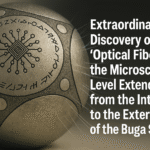







The Buga Sphere optical fiber discovery has electrified both the scientific and UFO research communities. The object, already known for its extraordinary composition and magnetic anomalies, now presents microscopic structures that could redefine the limits of ancient or extraterrestrial technology. Discovered by renowned biologist José de la C. Ríos López, this revelation intensifies the enigma surrounding the Buga Sphere.
Table of Contents
The Buga Sphere: A Recap of the Enigmatic Artifact
Before delving into the details of the Buga Sphere optical fiber discovery, it’s essential to understand the sphere’s established mysteries. Recovered in Colombia and subjected to preliminary metallurgical and physical tests, the sphere has shown a composition of over 95% aluminum alloyed with trace elements such as copper, manganese, and zinc. It has been classified as magnetically hard, with internal temperature fluctuation and structural layering previously seen only in synthetic or engineered materials.
Inside the Sphere: José de la C. Ríos López and the Discovery
The Buga Sphere optical fiber discovery stems from microscopic analyses conducted under high-resolution microscopy. José de la C. Ríos López, whose research also extends to the Nazca mummies, identified filaments resembling optical fibers extending from within the sphere to its outer casing. These structures were not random, rather, they followed linear and sometimes curved trajectories that strongly suggest intentional design.
Potential Function: Were the Fibers Transmitting Something?
While the Buga Sphere optical fiber discovery does not confirm what these fibers were used for, several hypotheses have emerged. The structures could theoretically act as conduits for light, energy, or data. This aligns with similar findings in engineered systems where optical fibers serve as mediums for ultra-high-speed information transfer. Could these micro-filaments have supported communication systems or even sensory functions?

Comparing Natural and Synthetic Structures
The filaments observed in the Buga Sphere optical fiber discovery challenge the notion of natural formation. They differ markedly from crystal inclusions or mineral veins. Their uniformity, transparency, and connection points mirror known characteristics of synthetic fiber optics. Unlike naturally occurring fibers, these appeared embedded with precision, suggesting advanced fabrication.
Material Integrity: Brinell Hardness and Aerospace Parallels
In tandem with the Buga Sphere optical fiber discovery, the artifact has tested at a Brinell hardness of 330. For context, that’s harder than most aerospace aluminum alloys. The implications are profound: not only does the sphere incorporate fiber-like structures, but it’s encased in a shell more durable than typical Earth-based manufacturing processes would suggest.

Scientific Community Reacts to the Discovery
Responses to the Buga Sphere optical fiber discovery have been mixed but impassioned. Material scientists note the engineering precision implied by the fiber paths. Biologists and anthropologists, including those studying the Nazca mummies, see parallels in the apparent merger of biological and technological traits. Reddit threads, forums, and independent researchers are actively dissecting the few available images and early lab results.
Bridging Buga and Nazca: Ríos López’s Broader Work
José de la C. Ríos López has drawn controversial attention due to his involvement in examining tridactyl beings in Peru. His role in the Buga Sphere optical fiber discovery adds another data point to the theory that humanity may be confronting a class of technology not currently known to mainstream science. If confirmed, this finding could mark a paradigm shift across multiple disciplines.
Frequently Asked Questions
What is the Buga Sphere optical fiber discovery? The identification of microscopic fiber-like filaments within the Buga Sphere that resemble synthetic optical fibers, extending from the sphere’s core to its outer surface.
Are these fibers proven to be artificial? Not conclusively. However, their structure and alignment are highly indicative of engineered design.
What are the potential uses of such fibers? Theories range from data transfer and energy conduction to sensory or surveillance purposes. This raises the question, what is the purpose of the Buga sphere, and who, or what is controlling it?
Has peer review confirmed the discovery? As of now, full peer-reviewed publication is pending. Independent labs are reportedly being invited to conduct confirmatory analysis.
Conclusion: The Buga Sphere Optical Fiber Discovery Demands Further Study
The Buga Sphere optical fiber discovery is not a minor anomaly, it could be a watershed moment in the ongoing evaluation of anomalous artifacts. With respected biologist José de la C. Ríos López spearheading the analysis, and with more studies underway, the world may soon face incontrovertible evidence of a technology beyond our known history. Whether ancient Earth-originating or truly non-human, the Buga Sphere continues to defy explanation, with its optical fibers hinting at an intelligence that once interfaced light, metal, and information in ways we are only beginning to understand.