




Introduction: Plasma Beings, NASA Cameras, and the New Frontier of Life
In recent years, the idea of plasma-based life has transitioned from speculative theory to a subject of serious inquiry. This shift is fueled by NASA plasma entity footage captured across multiple space shuttle missions, where astronauts and onboard instruments recorded kilometer-sized, self-luminous plasma anomalies behaving with intelligence-like motion.
Now, with the publication of the peer-reviewed whitepaper “Extraterrestrial Life in the Thermosphere: Plasmas, UAP, Pre-Life, Fourth State of Matter” by Joseph et al. (2024), these observations are finally receiving the scientific attention they deserve. From donut-shaped swarms around satellites to plasma beings rising from Earth’s upper atmosphere, NASA’s footage could mark humanity’s first observational contact with life in the fourth state of matter.
STS-48: The Footage That Sparked the Plasma Life Hypothesis
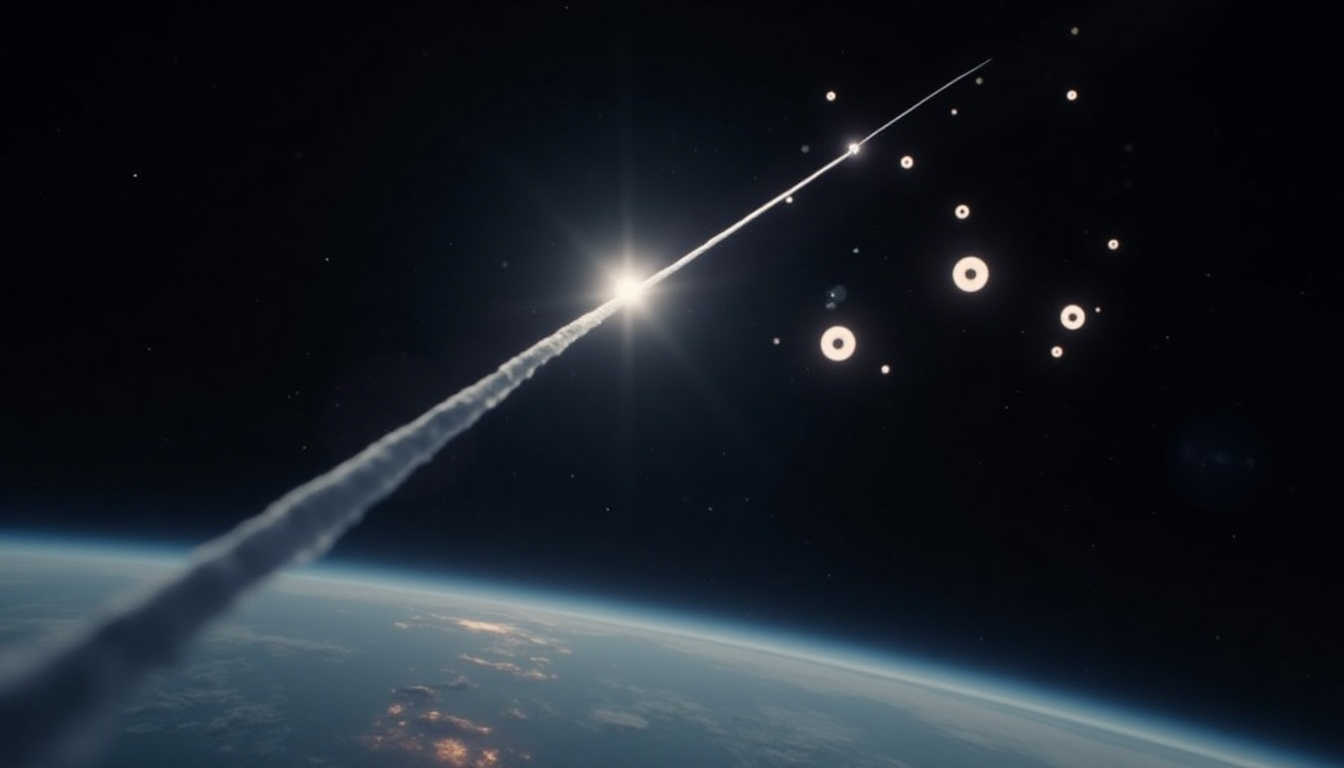
In September 1991, the STS-48 Space Shuttle Discovery mission inadvertently recorded what would become one of the most studied anomalies in spaceflight history. The onboard infrared night-vision camera captured a bright object making an instantaneous 90° turn after a flash of light, interpreted by some researchers as an energy projectile.

Dr. Mark Carlotto, an image scientist, analyzed the footage and concluded that the object exhibited non-ballistic movement inconsistent with orbital debris or ice particles. Joseph et al. (2024) cite this mission as the first example of “plasma intelligence,” noting that such behavior could indicate autonomous threat evasion or situational awareness.
STS-75: The Tether Incident and the Swarm of Luminescent Plasma Discs
During NASA’s 1996 STS-75 mission, astronauts attempted to deploy a 12-mile-long satellite tether system (TSS-1R) designed to test electromagnetic energy generation in orbit. The tether unexpectedly snapped, drifting freely in space. What happened next became one of the most controversial moments in NASA history.

Infrared footage showed dozens of donut-shaped, luminous plasma objects appearing around the tether. These entities displayed rhythmic pulsation, swarming behavior, and an apparent fascination with the electromagnetic signature of the broken tether. Some of them measured over a kilometer in diameter.
According to Joseph et al., the behavior suggests electrotaxis, a movement toward EM fields, implying the entities may be both energy-seeking and sentient in behavior.
STS-80: Witnessing Plasma Ascension From Earth to Orbit
The STS-80 Columbia mission in December 1996 provided yet another glimpse into a potentially plasma-based biosphere. Video footage revealed circular, self-illuminated entities ascending from Earth’s atmosphere into space, hovering momentarily, then vanishing.

Unlike standard orbital objects, these plasma forms moved against gravitational vectors, suggesting intelligent flight paths. The study published by Joseph et al. theorizes that these plasma beings inhabit the thermosphere, utilizing solar radiation and ionized particles as sustenance or propulsion.
This challenges the long-held belief that Earth’s upper atmosphere is lifeless. It may, in fact, be teeming with field-based intelligences invisible to the human eye. NASA plasma entity footage has been captured many times, which would suggest’s that there is probably more footage captured that we unaware of.
Scientific Features of the NASA plasma entity footage: Size, Shape, and Complex Behavior
What makes these sightings extraordinary is not just their presence, but their morphology and behavior. Across ten missions analyzed in the whitepaper, the plasma entities demonstrated the following characteristics:

- Shapes: Toroidal, spherical, amoebic, and cylindrical structures
- Size: Ranging from tens of meters to several kilometers in diameter
- Motion: Sharp directional changes (45°, 90°, even 180°), sudden stops, group congregation, and dispersal
- Communication?: Plasma dust trails and synchronized pulses may indicate a form of field-based signaling
The entities appear to operate with self-regulating principles, echoing biological intelligence despite lacking physical structure as we understand it.
NASA Plasma Entity Footage: Electromagnetic Attraction and Possible Intelligence
One of the most compelling arguments for intelligence comes from how these plasma beings interact with electromagnetic fields.
During missions such as STS-75, the whitepaper notes that the entities congregated around malfunctioning or active satellites, suggesting an attraction to EM energy. Some were even observed to modify their trajectory in response to EM emissions from the Space Shuttle itself.
This phenomenon mirrors electrotaxis in biology, the ability of organisms to detect and move toward electric fields, hinting at non-carbon-based cognition. Joseph et al. argue that such entities may possess field-aware intelligence, functioning more like self-organizing plasma computers than living cells.
Abiogenesis and the Evolutionary Potential of Plasma Entities
Joseph and his co-authors go a step further by hypothesizing a link between these entities and the origin of life itself. They propose that plasma fields, charged dust, and UV radiation in Earth’s thermosphere create the perfect incubator for abiogenesis.
Within these energy-rich environments, plasma beings might facilitate:
- Synthesis of amino acids or RNA components
- Formation of carbon-rich filaments
- Self-replication or mutation-like behavior
These plasma formations could be proto-life structures, occupying the gray area between chemical complexity and biological awareness, a concept long theorized in astrobiology but now observed on NASA’s own footage.
NASA’s Silence and the Classified Edge of Plasma UAPs
Despite the compelling footage and peer-reviewed analysis, NASA maintains its public stance: these are either space debris, ice particles, or lens artifacts. However, several independent researchers, and even former insiders, suggest the agency is aware of the anomalous nature of these sightings.
The whitepaper alludes to:
- Compartmentalized investigation teams
- Undisclosed telemetry and classified data
- Connections to UAP monitoring programs within defense agencies
As with many UFO/UAP phenomena, strategic ambiguity seems to be NASA’s current position. But with increasing civilian access to data and peer-reviewed literature, public pressure for disclosure is growing.
Conclusion: From Fourth State to First Contact?
The implications of NASA plasma entity footage go beyond scientific curiosity. They challenge our understanding of life, physics, and consciousness. These formations may not be alien visitors, but rather native intelligences that evolved in parallel to terrestrial biology, operating through energy, not matter.
As Joseph et al. conclude:
“The evidence suggests we may be observing a previously unknown category of life, prebiotic, intelligent, and native to the plasma-rich upper layers of our atmosphere.”
If proven, this would represent the discovery of a second genesis, not light-years away, but orbiting just above us.
📘 FAQ: NASA Plasma Entity Footage
Q: Has NASA admitted to the authenticity of the NASA plasma entity footage?
A: No. NASA officially attributes them to debris or artifacts. However, analysis from multiple missions and the whitepaper challenges this interpretation.
Q: Could the NASA plasma entity footage be alien probes?
A: It’s possible. Some theories suggest they may be non-biological, autonomous intelligences monitoring Earth.
Q: Are these entities dangerous?
A: No hostile behavior has been observed. Their interactions appear exploratory or reactive, not aggressive.
Q: Do they live on Earth or in space?
A: Most sightings occurred in the thermosphere, suggesting they may originate there, or even within Earth’s magnetic field zones.
📘 Glossary of Terms
Bioplasma Intelligence – A theorized type of sentient plasma entity exhibiting field-based cognition.
Toroidal Shape – A donut-like form, often used to describe plasma life shapes in STS-75 footage.
Thermosphere – A high-altitude atmospheric layer (~85–600 km) where most sightings occurred.
Plasma Dust Trail – Residual ionized particles emitted by plasma formations, potentially used for communication or motion.
Abiogenesis – The natural process by which life arises from non-living matter, often involving energy-rich environments like plasma fields.
📚 Sources & Citations
- Joseph, R., Schild, R., et al. (2024). Extraterrestrial Life in the Thermosphere: Plasmas, UAP, Pre-Life, Fourth State of Matter. SCIRP.org
- ResearchGate – Plasma Entities in Space