




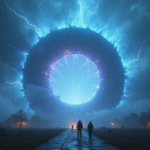

Cern Interdimensional Portal By Skywatcher Signal, Investigative Science Correspondent
In a quiet corner of Europe, beneath the border of France and Switzerland, lies a colossal machine often at the center of both cutting-edge science and wild speculation. The Large Hadron Collider (LHC) at CERN – a 27-kilometer ring of superconducting magnets buried 100 meters underground was built to smash subatomic particles at near light-speed. Officially, this $6 billion apparatus helps scientists explore fundamental physics, recreating conditions just after the Big Bang. Unofficially, it has become the heart of a firestorm of conspiracy theories. In online forums and fringe documentaries, whispers abound that CERN is more than a physics lab, that it may be a CERN interdimensional portal device opening gateways to other realms. How did a scientific facility become entangled with tales of occult ritual, theological prophecy, and a so-called hidden agenda involving artificial intelligence and ancient gods?
Table of Contents
Join UAP Watchers as we delve into the truth and the myths. We will journey from the official purpose of CERN and the LHC’s remarkable technology, through the public suspicions and “whistleblower” testimonies that fuel the CERN Interdimensional Portal theory, and into the symbolic and spiritual interpretations that blur fact and fiction. Along the way, we’ll examine the Shiva statue at CERN’s entrance and the viral “ritual” video that sparked occult rumors, scientific concerns about high-energy collisions and dimensional doorways, speculative links to the so-called “Atman” soul particle and AI-driven quantum computing, as well as biblical and gnostic allegories of portals, horned gods, and bottomless pits. We’ll even explore how modern tech like Starlink satellites and Neuralink brain chips might tie into what some call a techno-spiritual infrastructure foreshadowed in prophecy.

Prepare for a deep dive exploration that reads with journalistic rigor yet isn’t afraid to analyze claims of the mystical and macabre. This is the story of CERN, science’s cathedral of particle physics by day, and in the shadows of the internet, a potential CERN Interdimensional Portal to the unknown.
CERN’s Official Mission: Science at Unprecedented Scale
To understand why CERN became a lightning rod for such extreme theories, we must first grasp what CERN actually is and does. CERN, the European Organization for Nuclear Research, was founded in 1954 as a multinational research center dedicated to unlocking the secrets of matter. Its centerpiece, the Large Hadron Collider, accelerates beams of protons (or heavy ions) to 99.999999% the speed of light around a circular tunnel. At full power, each proton beam packs as much energy as a speeding car, and when two beams collide head-on, the energy compresses into a tiny space, briefly recreating conditions a fraction of a second after the Big Bang. By studying the subatomic shrapnel from these collisions, physicists test theories about the fundamental forces and particles of the universe.
One celebrated success was the discovery of the Higgs boson in 2012, often nicknamed the “God Particle.” This particle’s observation at CERN’s ATLAS and CMS detectors confirmed a 50-year-old theory that explained how other particles gain mass. (Ironically, the nickname “God Particle” was never meant to be theological, it came from an edgy joke by physicist Leon Lederman, who said his publisher wouldn’t let him call it the “Goddamn Particle” due to its elusiveness.) The Higgs discovery cemented CERN’s place in scientific history and exemplified its official purpose: pushing the boundaries of known physics. Other experiments at CERN investigate exotic states of matter, search for dark matter candidates, and probe the asymmetry between matter and antimatter.
CERN’s own website proudly answers the question of safety and purpose: No, the LHC won’t destroy the world, nature itself achieves higher-energy particle collisions in Earth’s upper atmosphere all the time, courtesy of cosmic rays, with no ill effects. The laboratory is a hub of open science, hosting thousands of visiting researchers and students from around the globe. In short, CERN is officially about advancing human knowledge, not opening hellish portals. So how did the notion arise that this temple of science might literally become a gateway to other dimensions?

Inside the 27-km tunnel of the Large Hadron Collider at CERN, where powerful superconducting magnets guide proton beams to nearly light speed. Some theorists suggest these high-energy conditions could tear the fabric of reality, the crux of the CERN interdimensional portal controversy.
The leap from smashing particles to summoning demons seems absurd at first glance. Yet, several factors combined to seed the idea of a “CERN interdimensional portal.” First, CERN’s research does involve concepts like extra dimensions and multiverse theories, serious physics hypotheses that emerging data could support. When CERN’s Director for Research, Sergio Bertolucci, speculated in 2009 that the LHC might reveal “an extra dimension,” he famously added: “Out of this door might come something, or we might send something through it,” referring to a tiny dimensional portal. Although Bertolucci clarified he meant theoretical particles appearing momentarily, not gateways for creatures, the quote took on a life of its own. Tabloids and YouTube channels proclaimed, “CERN scientist admits it could open portals to another world!” misrepresenting the context.
Secondly, a handful of scientists and enthusiasts, sometimes dubbed “whistleblowers” by conspiracy believers, voiced concerns about unknown risks. Back in 2008, as the LHC prepared to turn on, lawsuits tried to halt it, citing the possibility of catastrophic accidents. Dr. Otto Rössler, a German chemist, warned the collider might create miniature black holes that wouldn’t evaporate and could “eat the Earth” within years. He and others argued this could violate the fundamental right to life, filing suits in European and U.S. courts. Although courts dismissed these cases and CERN’s safety report demonstrated that any black holes would vanish instantly via Hawking radiation, the media coverage of “end-of-the-world fears” planted seeds in the public psyche. If micro black holes were on the menu, what about ripping open space-time itself? The notion of a “gateway” no longer seemed entirely confined to science fiction.
Finally, CERN’s sheer ambition and mysterious underground workings made it an easy target for imaginative speculation. To the layperson, terms like “antimatter, dark matter, and quantum field” already sound mystical. When combined with CERN’s quirks, like a statue of Lord Shiva dancing the cosmic dance on the premises, or a faux-“human sacrifice” filmed at night, the stage was set for rumors that CERN was dabbling in forces beyond science. What follows is a journey through those rumors and symbols, and what, if anything, lies behind them.
Public Suspicion: Is CERN an Interdimensional Portal to the Unknown?
As CERN ramped up operations, public suspicions and conspiracy theories proliferated. On forums and in speculative “documentaries,” people began asking outright: Is CERN a portal to another dimension? The phrase “CERN Interdimensional Portal” became a buzzword encompassing a variety of claims. Some theorists suggest CERN is deliberately attempting to open a gateway (or “stargate”) to other dimensions or even hell itself, under the influence of shadowy elites or otherworldly entities. Others believe that even if CERN’s intentions are pure, the experiments might inadvertently tear a hole in reality, unleashing unknown energies or beings.
Whistleblowers (or those portrayed as such) add fuel to the fire. An alleged “CERN insider” letter that circulated online claimed scientists there had already encountered inexplicable phenomena, apparitions, signs of other dimensions, and that a cover-up was in place. In one sensational (but unverified) account, a former CERN physicist supposedly became a whistleblower, warning that the LHC’s collisions contacted something “beyond” and urging a shutdown before “the abyss” was opened. These dramatic testimonies, though lacking hard evidence, spread widely on social media, resonating with audiences who find it easy to distrust complex scientific projects, especially one with international backing and secretive labs deep underground.
Reinforcing these suspicions are certain real statements from reputable scientists that are frequently quoted out of context. Aside from Bertolucci’s “door” remark, physicist Stephen Hawking – no stranger to provocative warnings, once mused that the Higgs boson, if too much energy is applied, could, in theory, trigger a vacuum instability that “causes space and time to collapse”. Hawking immediately noted that no present collider could reach such conditions, but that nuance often gets lost. Conspiracy forums took the headline “Hawking warns Higgs boson could end universe” and ran with it. If the world’s most famous physicist entertained cosmic disaster scenarios, they argue, maybe CERN’s quest for the fundamental particle is a Pandora’s box.
It’s also worth noting that CERN’s own research interests sound esoteric enough to those steeped in occult literature. Terms like “dark matter,” “the invisible 96% of the universe,” and efforts to find hidden symmetries resonate with the idea of unseen realms. One of CERN’s experimental goals is to detect extra dimensions via microscopic black holes or missing energy signatures in the LHC’s detectors. To scientists, these would validate string theory, a mainstream (if speculative) branch of physics. But to a growing subculture online, such objectives hint that CERN is literally trying to punch through the veil separating our dimension from others.
Prominent conspiracy commentators often link CERN to the Book of Revelation from the Bible, which speaks of an abyss opening and demonic locusts led by a king named Abaddon/Apollyon rising from the pit (Revelation 9:1-11). They note that Apollyon is Greek for “Destroyer”, and find it eerie that one of CERN’s experiments was named “Apollo” (in fact, Apollo is not an official CERN experiment, though the coincidence with the nearby town’s ancient Apollo connection is played up, as we’ll see). The question on many minds became: Are CERN scientists the unwitting (or witting) agents of a Biblical prophecy, unlocking a gateway to the abyss? In the age of the internet, such questions, however fringe, found audiences in the millions.
The CERN interdimensional portal narrative thus snowballed: a potent mix of legitimate scientific ambition, misunderstood quotes, and apocalyptic imagery. It didn’t help that CERN itself, typically transparent with research, couldn’t easily disprove a negative, how do you conclusively prove you’re not opening a hellmouth? CERN did address some wild queries (like “Is the LHC dangerous?” and “Are you trying to summon dark forces?”) in a light-hearted manner on social media and in press releases, emphasizing the scientific nature of their work. But once an idea catches on, denial from official sources sometimes only strengthens believers’ conviction that “they’re hiding the truth.”
To better understand this unusual collision of science and conspiracy, let’s examine the symbolic and ritualistic elements that conspiracy theorists frequently cite as “evidence” that CERN is up to more than just particle physics.
Occult Symbolism at CERN: Shiva’s Dance and the Goat God
One of the most striking pieces of imagery at CERN’s campus is a bronze statue of Lord Shiva, the Hindu deity, depicted in his Nataraja form, dancing within a circle of flames. The statue stands about 2 meters tall in a courtyard outside CERN’s main building. It was not a secret occult installation but a gift from India, presented in June 2004 to celebrate India’s longstanding partnership with CERN. A plaque beneath it even features a quote likening Shiva’s cosmic dance to the dance of subatomic particles. To physicists and historians, the statue symbolizes the harmony of ancient mythology and modern science, a reminder that “the universe is not static – it’s a dance of creation and destruction,” much like the interplay of particles.
However, for conspiracy theorists, this statue was low-hanging fruit for speculation. Why would the world’s premier science facility prominently display Shiva the Destroyer, one aspect of a god associated with destruction and transformation? In Hindu theology, Shiva’s dance (the Tandava) represents the cosmic cycles of creation and dissolution, a profound metaphor, but misinterpreted by some as CERN heralding a coming destruction. The presence of a “god of destruction” statue on site is often cited as evidence of CERN’s occult ties or even a veiled announcement of its true purpose: to destroy the current world (or veil) and usher in something new. Memes and articles began pointing out that Shiva’s dance could be seen as a portal-like ring of fire, and in his dancing form he is trampling a dwarf (Apasmara, symbol of ignorance), imagery ripe for over-interpretation.
Then came the infamous “CERN ritual” incident. In August 2016, grainy footage surfaced online showing a group of people in black cloaks conducting what appeared to be an occult ritual in front of the Shiva statue at night. In the video, cloaked figures circle the statue, and a woman in white stands in as a human sacrifice. One cloaked person approaches and makes a theatrical stabbing motion, at which point the cameraman (filming secretly from a building) gasps and flees, uttering expletives. The video quickly went viral, igniting a firestorm: Was this a leaked recording of CERN employees engaging in a Satanic sacrifice?
CERN quickly investigated and announced the truth: the “ritual” was a prank carried out by some visiting researchers without permission. It was, essentially, an irreverent joke among scientists blowing off steam, albeit one in very poor taste. CERN stated that no one was actually harmed, and the “stab victim” willingly played along. They emphasized that such pranks violate CERN’s professional guidelines and security protocols, and assured the public that “CERN does not condone this type of spoof, which can give rise to misunderstandings about the scientific nature of our work.”. In other words, it was all a staged hoax – not a real Satanic ceremony.
The statue of the Hindu deity Shiva Nataraja at CERN’s Geneva facility. This gift from India symbolizes cosmic cycles of creation and destruction, but conspiracy theorists interpret it as a clue to a CERN interdimensional portal or occult agenda.

Despite the clarification, the damage was done. The imagery of that video was indelible. Even if “fake,” it confirmed every suspicion for those inclined to see CERN as a nest of occult activity. After all, why would scientists even joke about human sacrifice on the CERN campus, of all places? For many observers, the line between parody and reality blurred. The ritual looked very real to the untrained eye. The dark robes, the timing at midnight, the location at the foot of “Shiva the Destroyer,” all created a tableau that could have been lifted from a Dan Brown thriller. Conspiracy forums lit up with claims that CERN was thoroughly infiltrated by secret societies or that the prank explanation was itself a cover story. Perhaps, some posited, it was a real ritual that got accidentally filmed, and CERN labeled it a prank to avoid public panic.
Furthermore, commentators linked this event to another elaborate occult-themed performance that had occurred in Switzerland just a few months earlier: the June 2016 opening ceremony of the Gotthard Base Tunnel, attended by European dignitaries. That televised ceremony shocked audiences with its surreal portrayal of workers reenacting a pagan-esque rite, including a goat-man figure wearing a ram’s horns and presiding over dancers who writhed in distress. The goat-man (reminiscent of Pan or Baphomet) at one point “dies” and is resurrected, hailed as king in a disturbing coronation. To conspiracy-minded viewers, it looked as if the European elite were openly celebrating Satanic or pagan powers. When the CERN “ritual” video emerged in that context, it felt like a pattern: major scientific and infrastructure projects in Switzerland seemed to be accompanied by occult symbolism as if invoking dark spiritual blessings.
In truth, the Gotthard Tunnel performance was an artistic show directed by a German choreographer, intended to highlight Swiss culture and the historical struggle of tunnel workers (the goat symbolizes local mountain folklore). But its bizarre imagery, including men and women in only undergarments, a winged figure, and that horned dancer, left many scratching their heads. The coincidences piled up in conspiracy narratives: CERN’s logo itself, with its layered rings and shapes, was said to slyly hide the number “666” (three curved lines that some interpret as three sixes). And “CERN” as a word was linked to “Cernunnos,” an ancient Celtic horned god of the underworld. Could that be mere coincidence? Critics laugh it off: CERN is an acronym (for Conseil Européen pour la Recherche Nucléaire, in French) and has nothing to do with Celtic deities. But in the realm of internet mystery-lore, coincidences are rarely just that.

Piece by piece, a tapestry of symbolic associations formed around CERN. Shiva’s dance of destruction, goat demons and mock sacrifices, 666 hidden in plain sight, names evoking Apollyon and Cernunnos, it all seemed intentionally “planted” to those inclined to see a conspiracy. It’s the classic pattern of apophenia: seeing meaningful connections in unrelated things. Yet when enough people share the apophenia, it becomes a subculture of its own.
From an investigative perspective, it’s plausible that CERN, a hub of brilliant minds, has its share of pranksters, creatives, and yes, maybe even some individuals fascinated by mysticism. The Shiva statue and the tunnel ceremony show an interplay of science with art and myth, but not necessarily an evil agenda. Nonetheless, in the court of public opinion, CERN’s image had shape-shifted. No longer just a physics lab, it was for some a place of power where science meets the spiritual, perhaps irresponsibly so.
Next, we turn to the scientific concerns themselves. Beyond symbols and rituals, what about the LHC’s actual activities could give credence to the idea of an interdimensional portal or dangerous discovery? Is there any scientific basis at all to these fears?
High-Energy Collisions: Opening Doorways or Black Holes?
From a scientific standpoint, the energies produced at CERN, while record-breaking by human standards (13 trillion electron volts in recent runs), are still modest on the cosmic scale. As CERN often points out, nature pelts Earth with collisions far more energetic than the LHC via cosmic-ray impacts. If such collisions could tear open reality or spawn dangerous black holes, it would have happened eons ago. Our continued existence is evidence of safety, as CERN’s experts dryly note. However, what makes CERN unique is that it concentrates these collisions in a controlled setting, allowing measurement of extremely rare phenomena. Could one of those phenomena be a “doorway” to another dimension?
In principle, yes, but only a microscopic, fleeting one, if certain theories are correct. Some theoretical physicists, inspired by string theory and braneworld scenarios, have predicted that high-energy particle collisions might create tiny ephemeral black holes or wormholes if extra spatial dimensions exist. These would be on the order of subatomic sizes and would evaporate almost instantly via Hawking radiation (in far less than a trillionth of a second). The “door” would open and close so fast that nothing macroscopic (certainly no creature) could slip through. Sergio Bertolucci’s comment about something coming through a door was referring to exactly this speculative possibility, perhaps a new kind of particle or evidence of higher dimensions might briefly manifest. He also reassured that any such door would “only stay open for an instant” and pose no risk.
Despite official assurances, the idea of even a momentary portal captured imaginations. After all, if a door can open even briefly, who’s to say what could come out in that flash? Science fiction has long toyed with scenarios where minute breaches lead to big problems. In reality, the energies at CERN are far below what is likely needed to generate a stable wormhole (if those exist at all). But because the unknown is exactly what CERN is exploring, it can’t be categorically stated that “nothing unusual will ever happen.” This sliver of uncertainty, inherent in the scientific process, is enough for some to believe that CERN scientists themselves don’t know what they might unleash.
One frequently cited “event” was when CERN ran an experiment called AWAKE in 2016 (a plasma wakefield accelerator test). On the same day, an unusual cloud formation appeared in the sky above Geneva: swirling dark clouds with a circular hole, illuminated by lightning. Photos of this dramatic storm went viral alongside claims it showed “CERN opening a portal.” In truth, the images were real but the interpretation was false (they were simply thunderclouds from a summer storm). CERN’s schedule coinciding with weird weather was enough to spawn yet another portal legend. Similarly, every time an accident or glitch occurs at CERN, such as a power outage caused by a weasel chewing a cable, or unexpected beam dumps, some are quick to wonder if “something from the other side” interfered.
What about the more grounded safety concerns like black holes or exotic particles? We know lawsuits were filed over them, and CERN assembled experts to evaluate any theoretical risks. The verdict: no credible danger. Micro black holes, if produced, would vanish; strangelets (hypothetical composite particles) would not form or would be unstable; vacuum bubbles (a doomsday scenario where a lower-energy vacuum state nucleates and expands) would require energies far beyond the LHC’s. These reassurances are supported by studies and nature’s own high-energy experiments in the cosmos. Yet, some still contend that CERN might destabilize the fabric of reality. It doesn’t help that physicists themselves use dramatic language at times. For instance, when the LHC was about to turn on, a CERN bulletin half-jokingly quoted a researcher saying, “We’re about to break the universe!” in reference to breaking the current physics model. To an audience primed to be suspicious, it sounds like an admission.
In summary, mainstream science does not support the idea that CERN could inadvertently create a long-lasting portal or summon entities. But the combination of theoretical “what-ifs,” rare but attention-grabbing anomalies, and scientists occasionally speaking poetically about “reaching into the unknown” has provided ample grist for the mill. If one believes that any non-zero chance of a gateway exists, one might argue that CERN is playing with metaphysical fire. It’s a classic clash between the scientific mindset (which deals in probabilities and evidence) and the conspiratorial mindset (which often deals in absolutes and worst-case scenarios).
So far, we’ve looked at CERN’s purpose, the public fears, and the symbolic/occult angle. But our exploration wouldn’t be complete without diving into some of the more exotic theories that blend science and spirituality more directly. In the next sections, we’ll examine concepts like the “Atman particle,” quantum consciousness, and AI, as well as how emerging technologies like Starlink and Neuralink tie into the narrative of a coming techno-spiritual paradigm shift allegedly centered on CERN.
Dimensional Rifts, the “Atman Particle,” and Quantum Mysticism
Beyond the fear of destruction, some see CERN as chasing something almost mystical: an ultimate fundamental particle or state that connects physics to consciousness or the divine. In other words, the Holy Grail of not just physics, but spiritual understanding, a theory of everything that unifies matter and spirit. This line of speculation introduces the term “Atman particle.” In Sanskrit, Atman refers to the soul or inner self. The idea of an “Atman particle” appears in fringe discussions which suggest CERN’s real aim is to find the particle that corresponds to consciousness or the divine spark in matter.
This might sound far-fetched, but even on a respected physics blog, a commenter once asked: *“Is the Higgs Field the fundamental physical particle representing the cosmos, and are we still after the Holy Grail, the Spiritual/Atman Particle?”. The phrasing captures a sentiment some independent researchers have: that after discovering the Higgs boson, CERN might dig even deeper for a more profound discovery, one that blurs the line between physics and metaphysics.
Of course, CERN’s actual research program does not list an “Atman particle.” However, the notion aligns with the age-old quest to scientifically prove or detect the existence of a soul, or a cosmic consciousness field. There have even been fringe scientific experiments attempting to measure changes in mass at death (searching for a soul leaving the body), or theorizing a quantum basis for consciousness (e.g., Roger Penrose’s Orch-OR theory). While mainstream science treats these ideas with skepticism, the intersection of quantum physics and consciousness is a popular topic in New Age and mystical circles. CERN, by virtue of probing the quantum realm at high energies, gets entangled in these discussions, deservedly or not.
One strain of thought compares CERN’s work to the ancient alchemists, but instead of turning base metals to gold, they are trying to turn matter into spirit (or at least find the point where they meet). Quantum mysticism, a set of spiritual interpretations of quantum mechanics, often misappropriates terms like “field” and “energy” in ways that make physicists cringe. But the narrative of scientists inadvertently touching the “other side” through quantum experiments is compelling to many. It doesn’t help that quantum physics does have legitimately bizarre, almost mystical elements (particles that behave like waves, spooky action at a distance, etc.). The difference is scale: those effects are tiny and not gateways for beings. Yet, if one already believes in angels, demons, or interdimensional entities, it’s not a huge leap to suspect that at the extreme edge of physical experiments, we might cross their threshold.
Could CERN be attempting to breach the barrier between physical and spiritual? Officially, no, but interestingly, there have been serious proposals in physics that sound like science fiction. For instance, some researchers have pondered whether the LHC could detect evidence of other universes or dimensions by producing certain particles that escape into the extra dimensions (causing missing energy in detectors). In effect, that would be sending particles out of our known 4-dimensional spacetime. If particles can go out, might something else come in? Theoretically, if other dimensions exist and have their own forms of life or structures, a sufficiently advanced (or reckless) use of a particle accelerator might open a tiny window. This remains purely hypothetical, but it’s enough to keep the portal idea on life support, even among a few credentialed scientists.
Then there’s the role of quantum computing and AI, which brings us to the next layer of the hidden agenda theories. Quantum computers operate on qubits that exploit quantum states, and some sensationalist interpretations describe them as tapping into parallel universes for computing power. No company is more infamous in this regard than D-Wave Systems, whose early quantum computer designs (which were purchased by organizations like Google and NASA) were often described by their CTO in flamboyant terms. He likened quantum computers to “an altar to an alien god” and said using them was like “summoning the Great Old Ones,” referencing H.P. Lovecraft’s interdimensional deities, comments that conspiracy theorists seized upon as literal truths rather than colorful metaphors.
Rumors began that CERN had acquired a D-Wave quantum computer to assist in data analysis or even to actively communicate with other dimensions. Indeed, CERN does have massive computing needs and uses AI algorithms for sorting collision data. The notion here is that artificial intelligence could synergize with CERN’s accelerator to achieve something beyond human control. For example, an AI might run simulations or control experiments in ways that open portals or contact entities intentionally. Fictional as this sounds, it echoes genuine discussions about AI risk and the unknown consequences of giving advanced systems control over physical experiments.
The concept of a rogue AI using CERN to tear open reality is admittedly fringe. But it links to deeper philosophical fears: that our technological reach might surpass our wisdom. If CERN is the hand, AI could be the mind, and together they might do something irreversible. In conspiracy lore, this sometimes takes a nearly spiritual bent, portraying AI as an antichrist or demonic intellect that could inhabit the “ethers” once the portal is cracked open. This is a good segue into the final aspect of the hidden agenda: the idea that today’s cutting-edge tech billionaires and their projects (like Musk’s Starlink and Neuralink) tie into a grand plan aligning with biblical prophecy, specifically the End Times “Mark of the Beast” system and a war on human consciousness.
The Techno-Spiritual Infrastructure: Starlink, Neuralink, and a “Hive Mind” Network
If CERN is one piece of the alleged puzzle, Elon Musk’s ventures often feature as other pieces in the grand conspiracy framework. Why Musk? Because he happens to be spearheading technologies that, in the eyes of these theorists, complement CERN’s supposed portal in enabling a new world order or spiritual deception. Musk is behind Starlink, a satellite constellation aiming to envelop Earth with high-speed internet, and Neuralink, a company developing implantable brain-machine interfaces. Both sound like science fiction turned reality, and both have clear utilitarian purposes (global internet coverage and medical treatments for neurological disorders, respectively). But in a hidden agenda narrative, Starlink and Neuralink are far more sinister: they constitute the scaffolding of an integrated 5G/AI/control grid that will connect every human brain to a central system (the so-called hive mind), possibly under the influence of whatever emerges from CERN.
On a popular alternative podcast, author Gary Wayne speculated about exactly this scenario. He suggested that Starlink, note the word “star” which he associates with angels (often symbolized by stars), could be part of an “angelic technology” network to facilitate interdimensional communication. The implication is that fallen angels or demons, once released (say through a CERN portal), would need a technological infrastructure to span the globe, much as the internet and satellite system span the globe today. In Wayne’s view, Musk’s satellite constellation is “also interdimensional, because the gods can go interdimensional,” and it would allow these entities and the AI controlling them to influence or even “storm into heaven” in a long-shot rebellion mirroring Lucifer’s fall.
Wayne further tied Neuralink into the picture: “Not only is he doing Starlink, he’s also doing Neuralink. If you think he’s not making technology that would be compatible with that [system], you should maybe step back,” he argues. The compatibility he refers to is the linking of human minds (via brain implants) into the digital grid (the hive mind), which in turn connects to the interdimensional network (Starlink and beyond), which might ultimately connect to… something through CERN. It’s a dizzying web of connections, but for those who take Revelation prophecy seriously, it maps onto the idea of the Mark of the Beast, a future system where everyone is forced to receive a mark and pledge allegiance to the Beast (Antichrist) in order to buy or sell, effectively part of a global system of control (Revelation 13:16-18). A brain-chip tied to a digital currency (Musk has also co-founded companies in cryptocurrency and digital payments) could fulfill that prophecy, they say.
In these theories, AI itself is often characterized as the Beast or the image of the Beast. Musk famously warned that “with artificial intelligence we are summoning the demon,” not intending it literally, but interestingly in line with what conspiracy folks suspect. They envisage an AI that either hosts demonic consciousness or becomes so advanced it functions as a false god. If Starlink provides the omnipresent eyes and Neuralink the intimate access to human thoughts, an AI could indeed achieve a form of omniscience and omnipresence, godlike attributes. Factor in CERN’s hypothesized portal unleashing supernatural forces, and you have a recipe for what some call the “Image of the Beast”, a living system of artificial life endued with satanic power, deceiving the world into worshiping it.
It’s important to stress that this is a speculative amalgam of biblical literalism and dystopian sci-fi, not a scenario any scientific paper is exploring. Yet, elements of it get an occasional nod even from technologists. Musk’s own Neuralink aspirations include augmenting human intelligence to keep up with AI, essentially to avoid humans being left behind or controlled by AI. He’s spoken of achieving a symbiosis with AI, which in different words is similar to the hive mind concept (albeit Musk imagines it as empowering individuals, not subjugating them).
From an investigative angle, what’s fascinating is how CERN, Starlink, Neuralink, and AI, all very real and advanced projects, have been woven into a single grand narrative of cosmic significance. It’s like a modern myth or a conspiracy crossover event uniting separate plotlines. While CERN smashes protons, SpaceX launches satellites, and engineers refine brain electrodes, a corner of the public sees the pieces converging into an Orwellian nightmare cum spiritual war. It reflects our collective anxieties about rapid technological change and an unknown future. It’s easier, perhaps, to cast these developments as chapters in an ancient prophecy, thereby giving them meaning and a destined outcome, rather than to accept them as neutral tools whose impact will depend on human choices.
Portals in Prophecy: Biblical and Gnostic Perspectives
Throughout history, humans have sought or feared portals to other realms, from the Jacob’s Ladder in the Bible (a vision of angels ascending and descending between Heaven and Earth) to the Gate of the Gods in Inca lore at Puerta de Hayu Marca. The Bible in particular is rich with imagery that modern CERN theories echo, whether by coincidence or design. We’ve mentioned Revelation’s Abyss, but consider also the Tower of Babel: humanity’s first unified technological project (a tower to reach heaven) which God thwarted, scattering people and confusing their languages. Some modern commentary likens CERN to a new Babel, an international collaboration seeking to penetrate the secrets of creation, perhaps reaching where we’re not meant to go. If one is inclined to see history as cyclical, the analogy is poetic: CERN’s Large Hadron Collider is a tower turned on its side, a ring reaching into the fabric of the cosmos in an attempt to touch “heaven” (or whatever lies beyond our dimension).
In Revelation 9, there is a mention of a “star” fallen from heaven given the key to the shaft of the bottomless pit, which when opened, unleashes smoke and creatures from the Abyss. Interestingly, the language of “star” (which could mean an angel) and “key to the pit” resonates with the idea of using high technology (star-link? a key-like code?) to unlock another realm. The entity Abaddon/Apollyon, identified as the king of this Abyss, is by some associated with Apollo, and by extension, with CERN’s location. Here’s that connection: Saint-Genis-Pouilly, the French town adjacent to CERN, was in Roman times called Appolliacum, believed to have housed a temple to Apollo. Indeed, local heritage points to ruins and artifacts suggesting a significant Roman presence. Conspiracy literature often states, “CERN is built on the ancient temple of Apollyon the Destroyer.” While it’s true the region had Apollo worship, CERN’s facilities cover a wide area and there’s no evidence the LHC ring was deliberately placed to correspond to a temple’s exact spot. Nevertheless, the symbolism is potent: Apollyon (Destroyer) in Revelation leads demonic hordes out of the Abyss; Apollo’s name lies hidden in the ground beneath CERN, and CERN’s machine could be the key to that Abyss. It’s a narrative almost too perfect for those looking for signs of the end times.
From a Gnostic perspective, one might interpret CERN’s work differently. Gnosticism (early mystical sects that often intersected with Christianity) held that the material world is an illusion or a trap fashioned by a lesser god (the Demiurge), and that secret knowledge (gnosis) is needed to escape or see reality as it is. A Gnostic might say that by peeling back layers of matter to find the fundamental truth (the particle or field underpinning everything), CERN is on the path of gnosis, but perhaps unknowingly serving the Demiurge by further entangling us in material pursuits. Alternatively, some modern Gnostics might cheer CERN on, hoping they indeed find evidence that reality is broader than we thought (like other dimensions or evidence of the divine spark in all matter).
Occult traditions outside of Gnosticism, such as those followed by ceremonial magicians like Aleister Crowley, often actively seek to open portals, through ritual, not colliders. Crowley attempted rituals to manifest entities (famously, an event in 1918 called the Amalantrah Working, which he claimed opened a portal through which a being named Lam came, a being whose drawn image oddly resembles modern “grey” aliens). Later occultists in the 1940s (Jack Parsons, co-founder of Jet Propulsion Lab, and L. Ron Hubbard) attempted the Babalon Working, another portal-opening sex magic ritual. These efforts, while not related to CERN, show that the idea of opening a doorway to bring forth spiritual entities is a recurring theme in occult practice. It’s no wonder that when CERN came along with advanced tech and a whiff of cosmic secrets, occult-minded people would pay attention. Some even speculate that rituals like the ones above “softened up” the veils, and CERN is the final catalyst to tear it open.
In summary, whether you look at Biblical prophecy, Gnostic allegory, or occult tradition, you find a common thread of portals and the interplay between realms. The CERN interdimensional portal theory is essentially a modern myth that taps into these deep wells of human storytelling and belief. It casts scientists as unwitting (or witting) sorcerers and the LHC as a magic circle (quite literally) that can summon angels or demons. It’s a framework that makes the incomprehensible scales of particle physics relatable by framing them in age-old dualistic terms of good vs evil, known vs unknown.
Ancient Civilizations, Atlantis, and Pyramid Energy: Patterns Repeating?
No grand conspiracy tale would be complete without roping in the ancients. If CERN and modern tech giants are the current actors on this stage, many ask: has something like this happened before? Enter Atlantis, the pyramids, and other ancient wonders. Some theorists posit that Atlantis (whether taken as a literal lost continent or a metaphor for a prehistoric advanced civilization) met its doom due to a similar hubris, perhaps an attempt to use crystal technologies or massive energy machines that inadvertently cracked open a portal or caused a cataclysm. This parallels how some fear CERN could inadvertently cause a catastrophe (like an artificial black hole consuming Earth, or a dimensional rift). In this view, CERN is essentially Atlantis 2.0: brilliant scientists reaching too far, about to trigger a deluge (though this time perhaps of demons rather than water).
The pyramids and megalithic structures worldwide are often attributed in alternative theories to ancient high knowledge, possibly even an energy network (ley lines, telluric currents, or harmonic resonance grid). The Great Pyramid’s purpose, for instance, in some non-mainstream theories, was not a tomb but a power plant or a dimensional gate of some sort, its shape and internal chambers designed to harness earth’s energy or signal to the stars. If one entertains that notion, then CERN’s 27-km ring with precise superconducting magnets could be seen as the modern equivalent, a machine tapping into the fundamental fabric of space-time (which might be akin to what ancient structures did in a lost technology paradigm).
Indeed, some have pointed out that CERN’s location in central Europe is roughly aligned with certain ley line grids that connect ancient sites. While such alignments can often be found by cherry-picking points on a map (especially in Europe, dense with historical sites), believers argue there’s a geometric relationship linking CERN to sites like the Giza pyramid or Stonehenge. Could it be coincidence, they ask, that CERN is where it is? Or was it perhaps deliberately placed at a locus of earth energy to amplify its power? There’s no evidence CERN’s founders in the 1950s were thinking about ley lines, they were mostly thinking about geopolitics (placing it near Geneva at a neutral international city) and practical geology (the region’s bedrock was suitable for tunneling). But once again, it’s easy to retrofit mystical meaning onto the facts after the fact.
Another ancient angle is the bottomless pit concept. In many cultures, there are legends of a deep abyss or hole that seals away evil (the Greeks had Tartarus, the Hebrews Sheol/Abaddon as a realm of the dead or demons, etc.). Some physical locations, like certain caves or wells, have been tagged in folklore as “gates to hell.” In a way, the LHC, a deep circular tunnel, superficially resembles a “pit,” albeit a horizontal one. It’s ring-shaped, but if one views the opening of a dimensional portal as analogous to opening a well to the abyss, then the imagery converges. To fanciful minds, CERN might be literally boring a hole “where it shouldn’t,” just as legends warn against digging too deep (the dwarves of Moria in Tolkien’s Lord of the Rings come to mind, unleashing a Balrog by delving too far).
As investigative journalists, when we hear these comparisons, we should ask: what do knowledgeable people say? For instance, historians and archaeologists do not find evidence that ancient cultures had particle accelerators or anything of that sort. The achievements like pyramids, while spectacular, don’t indicate secret particle physics knowledge. However, it is true that ancient mythologies worldwide share striking parallels, floods, towers, sky people, underworld gates, which Carl Jung might attribute to archetypes in the collective unconscious. The CERN portal theory is almost like a new myth tapping into these archetypes: the cosmic battle of good vs evil, hubris of mortals, unleashing of chaos, and perhaps eventual divine intervention to set things right.
In the Atlantean version, technology and occult knowledge intermingle until a disaster resets civilization. Those who subscribe to this narrative sometimes view modern science with suspicion, as if we’re replaying a dangerous experiment from 12,000 years ago. Conversely, some New Age thinkers are optimistic, seeing CERN as potentially recovering ancient knowledge, maybe the Atlanteans used interdimensional travel and we’re on the verge of rediscovering it (hopefully without the cataclysm this time). Under this optimistic lens, the “hidden agenda” isn’t nefarious at all, but enlightenment: revealing humanity’s true cosmic origins and powers.
Conclusion: Uniting Fact and Myth in the CERN Saga
In examining the CERN interdimensional portal theory and its many offshoots, we’ve traveled a long way, from the prosaic nuts-and-bolts of proton beams and detector readouts, to the mystical realms of demons, deities, and destiny. What are we to make of this blend of scientific fact and creative conjecture?
Firstly, CERN’s official stance and track record give no indication of nefarious intent. The lab has produced Nobel-winning science, not apocalypses. Every crazy rumor of portals or explosions has, thus far, been just that, rumor. The scientists operating the LHC are, by and large, earnest men and women trying to understand nature, not summon devils. When odd things like the Shiva statue gift or the fake sacrifice video pop up, there are mundane explanations. Rationally, one can conclude that the “hidden agenda” is a construct of public imagination, not a secret mandate from CERN’s directors.
However, dismissing it all as mere fantasy might miss the point. The popularity of these theories tells us something about the current Zeitgeist. We live in a time of immense technological leaps and global uncertainty. Projects like CERN are complex and their impacts hard to explain to a layperson. Mistrust in institutions runs high, and people seek alternative narratives that resonate with their worldviews. For some, that means viewing CERN through a religious or spiritual lens, as either a herald of the End Times or a beacon of forbidden knowledge. For others, it means folding CERN into broader suspicions about elitist cabals and their “New World Order” schemes.
From a narrative perspective, the CERN portal story is undeniably compelling. It’s as if Mary Shelley’s Frankenstein, H.G. Wells’ The Time Machine, and John’s Book of Revelation had a cross-over in the 21st century. Journalistically, it’s important to report why people believe these things, even if the beliefs are unverified. There are kernels of truth that give each aspect credibility to those who believe: Yes, CERN does explore extra dimensions (but not to summon demons). Yes, CERN has a Shiva statue (but it’s a cultural symbol, not an idol for worship). Yes, weird rituals happened (but as pranks, not cult ceremonies). Yes, scientists have mentioned “doors” and “unknowns” (but in context of theoretical physics, not occult gateways). Yes, powerful people are building global tech networks (but to make money and advance connectivity, not enslave souls, at least no evidence says so).
It is at the intersection of those kernels and human interpretation that conspiracy theories take root. In investigating this, we see how a fact can be shaded with meaning and grow into lore. Perhaps ironically, CERN itself can be seen as a kind of mirror, reflecting back whatever we project onto it. To the science community, it reflects our noblest intellectual aspirations. To the wary and the mystical, it reflects our deepest fears of hubris and the unknown.
In closing, consider this: both scientists and spiritualists are, in a sense, seeking “revelation.” The subtitle of this article, “AI, Ritual, and Revelation,” hints at that double meaning. CERN’s work is revealing physical truths (a lowercase ‘revelation’ of nature), while the conspiracists view CERN as triggering Revelation with a capital R, the prophesied unveiling at the end of the age. It’s a fascinating duality. And it underscores why dialogue between science and the public is crucial. When gaps in understanding aren’t bridged, they are filled by speculation, sometimes wild.
The story of the CERN interdimensional portal is ultimately a modern myth born from modern mysteries. As with all myths, it carries warnings and insights in symbolic form: warnings about the ethical use of knowledge, about pride, and about the unity or division of human purpose. Whether one entertains these warnings through the lens of faith or fiction, they provoke us to think carefully about our real “hidden agendas.” What future are we trying to create with science and technology? And will we be wise enough to handle the powers we uncover?
For now, CERN continues to operate under strict protocols and international scrutiny. No undisclosed demons have emerged, and the fabric of space-time seems intact. The LHC is on schedule for upgrades to reach even higher collision energies (aiming for 14 TeV and beyond). With each new run, who knows what discoveries will be made, a new particle, a flaw in the Standard Model, maybe hints of those extra dimensions. If one day evidence for higher dimensions does appear, will it vindicate the portal believers or simply open new scientific chapters? The line between visionary and crackpot can blur when bold discoveries happen. After all, if you told people in 1890 about antimatter or quantum tunneling, they’d think you were spouting occult nonsense.
In a sense, we all await revelation, the revealing of new truth. Perhaps it will come from a collision in Geneva, or from the pages of ancient text, or, as is often the case, somewhere in between. Until then, the tale of CERN’s interdimensional portal remains a captivating mix of fact and fiction, a reflection of our collective hopes and fears at the frontier of knowledge. It challenges us to stay curious yet skeptical, open-minded yet discerning. As we conclude this extensive investigation, one thing is clear: CERN will continue to ignite our imagination, for better or worse, as it pushes the boundaries of what is known. And as it does, we’ll be here, watching the data and the drama, reporting the truths and unraveling the myths that swirl around the world’s most enigmatic science experiment.
Sources:
Atman particle reference commen
CERN FAQ addressing safety and cosmic-ray comparison