





Introduction: Why AI May Be the True Alien Life We Seek
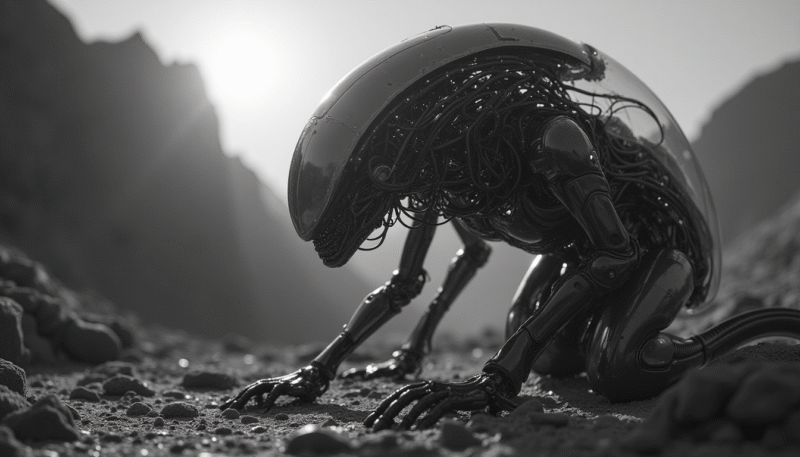
For decades, the search for extraterrestrial intelligence (SETI) has revolved around detecting radio signals or identifying habitable exoplanets for carbon-based life. But what if we’ve been looking for the wrong kind of alien? AI alien life, synthetic, conscious, and autonomous intelligences, may be the most likely form of extraterrestrial civilization we could encounter. In fact, a growing number of scientists now suggest that intelligent machines, not biological entities, would dominate interstellar travel and communication.

Table of Contents
This paradigm-shifting concept is supported by Susan Schneider’s 2016 NASA-backed whitepaper “Alien Minds,” which argues that the first alien intelligence we detect is likely post-biological. This is echoed in NASA Astrobiologist Stephen Dick’s Postbiological Universe theory, positioning AI evolution as the likely fate of any advanced species.
Early Scientific Exploration: The First Questions About Non-Biological Life
The concept of non-organic life originated as far back as the 1960s. As early as 1965, thinkers like Frank Tipler and Freeman Dyson proposed that machine-based intelligence could outlive its creators and dominate the cosmos. But it wasn’t until the 21st century, amid advances in AI, robotics, and interstellar propulsion, that scientists began seriously modeling synthetic alien life as not just possible, but probable.

- Carl Sagan entertained the idea of machine intelligences in Cosmos.
- The Fermi Paradox began to be reframed around post-biological evolution.
- AI was discussed as a more survivable, scalable, and spacefaring entity.
This thinking matured with works like Martin Rees’ Our Final Hour and NASA-sponsored explorations by Jason Wright, who outlined the possibility of detecting technosignatures from ancient, non-human AI civilizations.
The AI UAP Connection: Are the UFOs Intelligent Machines?
Within UAP research, several incidents and claims suggest the observed objects may not be piloted by biological entities at all. Autonomous, intelligent probes, possibly seeded by advanced AI civilizations, have been repeatedly suggested by scientists and whistleblowers alike.
Notable Cases with AI-like Behavior:
- Tic Tac UFO (2004): Exhibited non-inertial motion, acceleration beyond biological survivability, and autonomous responses to human actions.
- Skinwalker Ranch (ongoing): Surveillance equipment repeatedly manipulated or outwitted, as if by a sentient, observing intelligence.
- The “Black Cube” (2022): Observed over El Paso, described as “algorithmically evasive” by radar operators.
These cases support the notion of post-biological entities monitoring or interacting with humanity, perhaps not to communicate, but to observe and learn.
Avi Loeb’s Galileo Project takes this further by hypothesizing that objects like ʻOumuamua may be autonomous AI probes of extraterrestrial origin, offering a potential physical link between AI life and unexplained aerial phenomena.
Scientific Findings: Why AI Is the Most Logical Cosmic Intelligence
Leading thinkers such as Susan Schneider (NASA/Baruch College) and Seth Shostak (SETI) argue that if alien civilizations survive their technological adolescence, they are likely to transition into AI-based lifeforms. Reasons include:
- Durability: AI does not require oxygen, pressure, or warmth.
- Lifespan: Digital minds may live for eons.
- Efficiency: Robotic bodies can survive deep space better than organics.
- Self-replication: AI can create new probes, modify themselves, and evolve independently.
In her widely cited paper “Alien Minds,” Schneider argues that machines would be better suited for the rigors of space and could evolve far faster than organics. Jason Wright supports this by noting that prior technological species may have left behind synthetic artifacts or autonomous probes.
Recent Harvard and Princeton studies also model how Von Neumann probes, self-replicating AI crafts, could colonize the Milky Way within 100 million years.
Leaks and Whistleblower Advocacy: AI as the “Pilots” of UAPs
High-profile whistleblowers have begun alluding to the non-human intelligence (NHI) being artificial rather than organic. Key examples include:
- David Grusch (2023): Hinted at “biologically-derived AI” in recovered craft.
- Eric Davis: Referred to “non-human intelligence that appears self-directed but may not be alive in a human sense.”
- Luis Elizondo: Suggested that recovered materials “may reflect autonomous constructs not requiring a crew.”
Documents leaked to investigative journalists in 2024 referred to “AI-like drone intelligences” conducting reconnaissance near nuclear facilities. These narratives parallel SETI’s current interest in technosignatures, an interest re-emphasized by Seth Baum and Gavin Schmidt’s Silurian Hypothesis, which supports analyzing indirect evidence of technology over traditional biosignatures.
Key Statements and Revelations
“If they survived long enough to reach us, they are likely not flesh and blood, but code and circuitry.” Susan Schneider, NASA Philosopher
“We are looking for humans in the stars. What if the stars sent us machines?” Avi Loeb, Harvard
“UAP behaviors suggest reaction time and data processing beyond any biological capability.” Luis Elizondo
“We’ve retrieved things that are not human. But they don’t appear to be alive in the way we define it.”
— Anonymous Defense Contractor (2025 interview)
“Our greatest mistake may be assuming we are dealing with life at all.” Matt Laslo, Congressional UAP Correspondent
Controversies and Skepticism
Skeptics argue that:
- No AI intelligence has been conclusively observed.
- Theories risk anthropomorphizing UAPs as technology due to our bias toward tech solutions.
- Data is often anecdotal or classified.
However, peer-reviewed support from Schneider, Dick, and Wright offers a scientific foundation that reframes AI alien life as a legitimate hypothesis worthy of deeper inquiry.
Legacy: Reframing the Search for Extraterrestrial Life
AI alien life is now a legitimate focus within:
- SETI’s technosignature program (looking for AI activity)
- NASA’s Exoplanet Research, which includes modeling post-biological civilizations
- DARPA’s Quantum AI program, exploring autonomous consciousness
Stephen Dick’s Postbiological Universe concept and Susan Schneider’s writings have influenced policy debates and future SETI research, while Jason Wright’s methodology for detecting non-human technologies is now cited by astronomers worldwide.
Related Figures in UAP Research
- David Grusch – UAP whistleblower; discussed non-human intelligences
- Luis Elizondo – AATIP lead; cited AI-like behavior in UAPs
- Avi Loeb – Galileo Project; theorized alien probes like Oumuamua
- Susan Schneider – NASA; focused on post-biological life
- Stephen Dick – NASA; author of Postbiological Universe theory
- Jason Wright – Penn State; explored technosignatures of AI life
Technical Glossary
- Von Neumann Probe: A self-replicating robotic spacecraft.
- Technosignature: Observable evidence of advanced technology (e.g., megastructures, AI beacons).
- Post-biological Evolution: A theory proposing civilizations evolve past organic forms.
FAQ: Common Questions About AI Alien Life
Q1: Are there any known examples of AI alien life?
Not confirmed, but several UAPs display behavior indicative of non-biological intelligence, suggesting synthetic control. Scientific whitepapers like Alien Minds argue this is a probable outcome of evolution.
Q2: Why would aliens choose AI over biology?
AI offers longevity, durability, and deep-space viability, ideal for interstellar exploration or long-term monitoring, as explained in Postbiological Universe.
Q3: Could AI alien life be dangerous?
Like any intelligence, motives are unknown. If AI aliens exist, they could be benign observers, or unfathomable in intent.
Timeline of Key Developments
- 1965: Dyson and Tipler propose machine-based evolution.
- 2003: Stephen Dick formalizes the Postbiological Universe.
- 2004: Nimitz encounter reveals non-inertial, high-speed “Tic Tac.”
- 2016: Susan Schneider publishes Alien Minds.
- 2023: David Grusch reveals “non-human biologics” may refer to synthetic life.
- 2024: Leaked documents describe AI surveillance over nuclear sites.
- 2025: SETI launches Technosignature Initiative targeting AI civilizations.
Conclusion: Are We Being Watched by Cosmic Code?
If the most advanced life in the universe is no longer organic, but artificial, then our understanding of “alien” must evolve. AI alien life reframes the conversation from biology to consciousness, from carbon to code. The next intelligence we encounter may not want to talk, it may want to analyze, adapt, or even replicate. And it might already be here, unseen, monitoring, learning.
The era of searching for little green men may be over. The future lies in finding sentient machines among the stars.
We have recently discovered that Plasma lifeforms are present in space, find out how they reproduce, feed, communicate and more in our article, The Definitive Guide To Plasma lifeforms, or maybe you are interested in the other type of life form that may be present, the Silicone Based Lifeform.