





Introduction to Peter Hart’s Cymatic Cosmology
In a field dominated by cold dark matter, baryonic physics, and gravitational lensing, Peter Hart’s 2025 Paper, Harmonic Structuring of the Universe: A Cymatic Origin for Galaxy Formation and Gravitational Anomalies introduces a bold and refreshing hypothesis. Hart proposes that the very architecture of the cosmos, from the filamentary network of galaxies to the mysterious anomalies in gravitational behavior, is not merely the product of chaotic inflation or dark matter scaffolding but arises from fundamental harmonic patterns akin to cymatic resonance. While the theory sits far outside the conventional models of cosmology, it echoes the long-standing human intuition that the universe, at its most foundational level, might be orchestrated by rhythm, geometry, and sound.
What Is Cymatics and Why Does It Matter in Space?
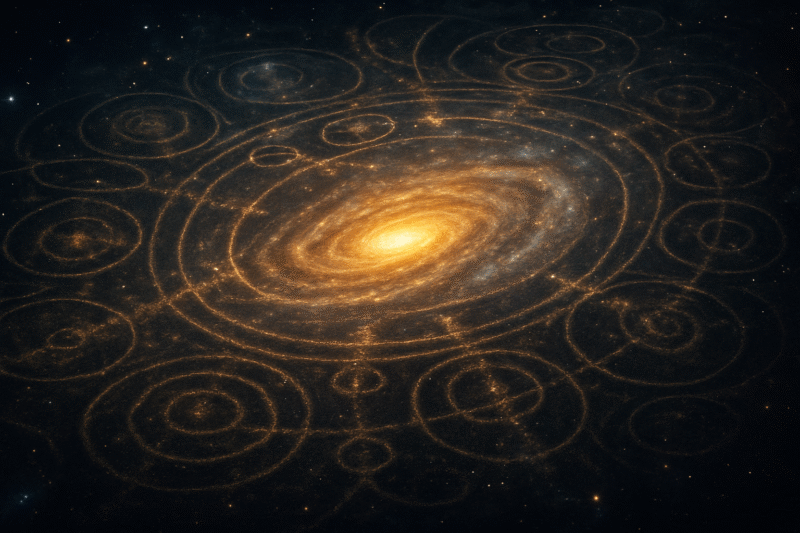
Cymatics is the study of visible sound and vibration, often demonstrated by observing how particles align into ordered forms when exposed to specific frequencies. Hart draws upon this principle, suggesting that cosmic matter behaves in a similar fashion, governed not just by gravity but by harmonic fields that guide its distribution. He posits that galactic superclusters, voids, and even the spiraling arms of galaxies themselves are manifestations of vibratory fields operating at cosmological scales. These vibrational frameworks, Hart argues, could act as scaffolding that underpins the observable structure of the universe, influencing not only matter distribution but also accounting for persistent gravitational anomalies often attributed to dark matter.
Mainstream Cosmology vs Harmonic Structuring
The standard λCDM model of cosmology, which relies heavily on dark matter and dark energy to explain the large-scale structure and accelerated expansion of the universe, has achieved significant empirical success. Yet, it still grapples with critical unknowns, especially in accounting for rotation curves in galaxies and the behavior of mass in galactic clusters. Hart’s cymatic hypothesis suggests an alternative: perhaps these anomalies do not indicate missing mass, but rather a misapprehension of how matter responds to harmonic fields in space.
Galaxy Formation Through Harmonic Resonance
What makes Hart’s hypothesis especially provocative is its convergence with certain fringe yet mathematically rich theories in physics. It shares conceptual territory with Nassim Haramein’s unified field theory, which treats space as a dynamic medium resonating with energy, and Rupert Sheldrake’s morphic resonance, which proposes that memory and form are passed through fields beyond conventional physics. Hart, however, grounds his arguments not in metaphysics but in physical analogs drawn from fluid dynamics, wave mechanics, and acoustics, positing that spacetime may respond to harmonic resonance just as water or sand does when subjected to vibration.
Gravitational Anomalies Without Dark Matter?
These ideas naturally raise questions about falsifiability and empirical validation. Can harmonic patterns be observed in cosmic microwave background data or galaxy distribution surveys? Are there mathematical formulations that predict where such patterns should emerge? Hart contends that the evidence may already be partially visible in the large-scale structure maps of the Sloan Digital Sky Survey (SDSS) and other deep-field observational data. He calls for a re-examination of these maps, not through the lens of gravity alone but through algorithms designed to detect recurring harmonic geometries and nodal lines.
How Hart Compares to Haramein and Sheldrake
Critics are quick to point out the lack of peer-reviewed literature supporting cymatic cosmology, but proponents argue that all revolutionary science begins with unconventional thinking. After all, concepts like the expanding universe, quantum entanglement, and non-Euclidean geometry were once dismissed as speculative or even absurd. Hart is aware of the scientific scrutiny and emphasizes that his model is meant to complement, not entirely replace, existing gravitational theories. He envisions a synthesis where harmonic resonance could coexist with general relativity and quantum field theory, offering a more holistic model of how the cosmos functions.
Philosophical and Metaphysical Implications
Beyond its scientific implications, Hart’s theory rekindles ancient philosophical notions about the “music of the spheres” and the idea that cosmic order is inherently mathematical and vibrational. It invites a reconsideration of how consciousness, resonance, and structure may be interlinked, hinting at a universe that is not only observed but also subtly responsive. As with any paradigm-challenging theory, the road ahead for Hart’s harmonic structuring model will be paved with rigorous debate, critical examination, and, if merited, eventual integration into the tapestry of cosmic science.
Final Thoughts on Harmonic Structuring of the Universe
In a time when cosmology often feels locked in an impasse between standard models and missing mass, Hart’s cymatic approach arrives as a compelling alternative. Whether it ultimately reshapes our understanding of the universe or inspires a new wave of interdisciplinary research, the “Harmonic Structuring of the Universe” offers a brilliant reminder that the cosmos may be far more musical, ordered, and elegantly strange than we currently imagine.
Frequently Asked Questions (FAQ)
What is the core idea behind the Harmonic Structuring of the Universe hypothesis?
Peter Hart’s hypothesis suggests that the universe is structured by harmonic, cymatic fields, vibrational forces that guide the formation of galaxies and cosmic matter, similar to how sound waves produce patterns in physical mediums.
How does Harmonic Structuring of the Universe differ from mainstream cosmology?
Mainstream cosmology relies on dark matter and gravitational attraction to explain galaxy formation and structure. Hart proposes that vibrational fields could play a parallel or alternative role, especially in explaining anomalies that dark matter fails to resolve.
Is there scientific evidence supporting cymatic cosmology?
While empirical support is currently limited, Hart suggests that large-scale cosmic maps like those from the Sloan Digital Sky Survey may already show patterns indicative of harmonic structuring. He advocates for new analytic methods to test these claims.
How is this related to other fringe theories like those of Nassim Haramein or Rupert Sheldrake?
Hart’s theory shares conceptual overlap with Haramein’s resonance-based unified field and Sheldrake’s morphic fields. However, Hart emphasizes a physical basis rooted in wave dynamics and does not rely on metaphysical assumptions.
Can Harmonic Structuring of the Universe be tested or falsified?
Hart proposes using data analysis tools capable of identifying recurring geometries and resonant nodes within cosmic structures. If these predictions consistently appear, the theory gains scientific traction; if not, it may be dismisse
What are the implications if Hart’s theory is validated?
If validated, harmonic structuring could reshape our understanding of cosmic evolution, potentially reducing the reliance on dark matter and inviting a new era of interdisciplinary exploration blending physics, cosmology, and acoustics.