






Quantum Mirroring is more than just a theoretical curiosity, it’s a profound glimpse into the reflective symmetry of the universe. Far from a poetic metaphor, it reveals that reality itself might be structured by interactions that behave like reflections, just not the kind you’re used to seeing in your bathroom mirror.
Table of Contents
In the realm of quantum mechanics, where entangled particles defy distance and superpositions warp linear logic, quantum mirroring emerges as a powerful concept. It’s a frontier where wavefunctions echo across boundaries, information bounces without traveling, and mirrored versions of particles appear as if reality itself has a dual.
In this deep dive, we’ll explore how quantum mirroring reshapes not only the way we perceive particles, but the way we perceive reality itself.
What Is Quantum Mirroring?
To understand quantum mirroring, imagine you’re standing before a perfect mirror. Classically, light rays bounce back to form your reflection. But in the quantum realm, mirrors don’t merely reflect, they transform, interact, and entangle.
Quantum mirroring refers to the phenomenon in which quantum states behave as if reflected by an invisible mirror, creating what are known as virtual mirror states. These states can arise in various contexts: from particle-wave duality and electromagnetic boundary conditions to entanglement structures and even brain dynamics. The “mirror” here is not made of silvered glass, it could be a vacuum boundary, a gravitational field, or even the fabric of spacetime.

When an atom or particle approaches a reflective quantum boundary (say, a nanostructure or an event horizon), it doesn’t merely bounce off. Instead, its wavefunction becomes entangled with its mirrored counterpart. What this means is that the original and its reflection become one unified, interdependent state, altering behavior, phase, and measurable properties in real time.
The Physics Behind Mirror States and Quantum Superposition
Wavefunction Duality and Reflection
In quantum mechanics, a wavefunction represents the probability cloud of a particle’s location and momentum. When this cloud approaches a boundary, such as a reflective quantum surface, the wavefunction is not destroyed, it splits, interferes with itself, and creates standing waves.
This phenomenon can create a mirror state, where the original particle’s probability is echoed on the other side of the boundary, even if no particle physically crossed it. The “mirror” version is virtual, yet real enough to affect outcomes.
This lies at the heart of quantum mirroring, the creation of an echo of reality across an invisible frontier.
Boundary Conditions and Virtual Images in Quantum Fields
Every quantum system obeys strict boundary conditions. When electrons or photons hit a physical or energetic boundary (such as a metal plate or a dielectric), their fields interact with the potential at that boundary, sometimes resulting in quantum reflections even in the absence of material contact.
The famous Casimir Effect arises from this exact interaction. Two uncharged plates, placed nanometers apart in a vacuum, experience an attractive force due to mirrored vacuum fluctuations between them. In effect, the quantum vacuum itself acts as a mirror, a mirror made of nothing.
Quantum Mirrors and Experimental Proof
Bose-Einstein Condensates Near Reflective Barriers
In 1999, physicists successfully demonstrated quantum reflection using ultracold atoms from a Bose-Einstein condensate. These atoms, cooled to near absolute zero, approached a reflective surface but never made contact. Instead, their quantum wavefunctions reflected due to long-range electromagnetic interactions. These weren’t normal reflections. These were mirrorings of probability amplitudes, where the atom never “bounced” but altered trajectory through wave interference.

The Mirror Atom Experiment (Heidelberg, 2011)
In a stunning 2011 experiment, researchers in Heidelberg placed atoms near superconducting mirrors and observed changes in energy levels, attributed to virtual mirror image atoms. These images were not detected directly, but their influence on atomic transitions was measurable. This effect could only be explained if the atoms were interacting with reflected versions of their own quantum states.
Gravitational Wave Mirrors and Quantum Behavior of Mass
In more recent theoretical models, scientists are exploring quantum mirrors for gravitational waves, using massive quantum systems as reflectors. This may lead to new ways of measuring ripples in spacetime itself, where mirrors are no longer material surfaces but entangled mass fields acting as gravitational echo chambers.
Quantum Mirroring vs Classical Reflection: What’s the Difference?
Why Mirrors in Quantum Physics Are Not “Surfaces”
In classical optics, mirrors reflect due to physical interactions with light. But quantum mirrors operate on information and interference. The “reflection” does not need a surface. It happens across field gradients, virtual particles, or nonlocal entanglements.
Think of it this way: in quantum mirroring, reality reflects across probability boundaries, not physical ones.
Role of Vacuum Fluctuations and Quantum Fields
Even “empty” space isn’t really empty. Quantum field theory reveals that vacuum is teeming with virtual particles. When real particles enter such environments near strong boundaries, they interact with these fields, and in doing so, produce mirror effects with measurable consequences.
This is part of why quantum mirroring isn’t a fringe idea. It’s embedded in the fabric of particle physics and quantum electrodynamics.
Consciousness and the Quantum Mirror Hypothesis
Here we move into speculative, but scientifically inspired, territory.
Quantum Brain Dynamics and Internal Reflection
Some models of consciousness, particularly those advanced by physicists like Sir Roger Penrose and Stuart Hameroff, propose that quantum coherence within brain microtubules might give rise to consciousness. In these models, internal quantum reflections may serve to stabilize or mirror conscious experiences.

This suggests a fascinating idea: your awareness might depend on quantum mirrors inside your neurons, echoing quantum information across hemispheres, and perhaps across dimensions.
Nonlocality of Observer-Reflected States
When you observe a particle, you collapse its wavefunction. But what if that observation is itself mirrored in another domain? Some interpretations (such as the Many-Worlds theory) imply that mirror states of you observe mirror states of particles in parallel realities.
Quantum mirroring, in this context, isn’t just a technical effect. It may be a gateway between dimensions of perception.
Technological Applications of Quantum Mirroring
Quantum Computing Stability Through Mirror Qubits
Mirror qubits, qubits entangled with mirrored counterparts, may offer a way to stabilize quantum computation. These ghost-like reflections are less susceptible to noise, decoherence, or entropy. Some models suggest dual-rail logic gates that use mirrored qubit states to perform error-resistant calculations.
High-Fidelity Quantum Sensors and Metrology
By exploiting quantum mirroring, researchers are designing hyper-sensitive measurement systems. Mirrors at the quantum scale amplify signals from gravitational fields, magnetic waves, and even dark energy, because they interact with mirrored fluctuations not bound by distance.
Does the Universe Use a Mirror? The Cosmological Implications
CPT Symmetry and the Mirror Universe Theory
One of the most exciting areas where quantum mirroring might apply is cosmology. According to CPT symmetry, every particle has a corresponding anti-particle, and the universe might even have a mirror counterpart, a twin expanding backward in time.
Quantum mirroring on this scale implies that our entire universe might be the reflection of a deeper, hidden one, each governed by symmetric but inverted laws.
Quantum Mirrors at Cosmic Scales
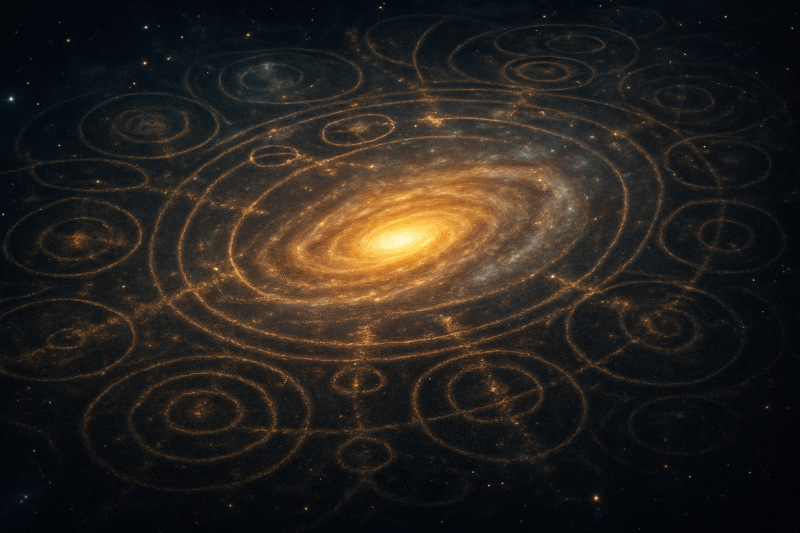
Gravitational lensing, black hole event horizons, and even cosmic inflation may all exhibit forms of quantum mirroring. The shape of the cosmic microwave background might one day reveal that the universe reflects itself, through time, energy, and consciousness.
Final Thoughts: Are We Looking into a Quantum Mirror Right Now?
It’s tempting to dismiss quantum mirroring as a metaphor. But this isn’t metaphorical physics, it’s measurable, mathematically defined, and increasingly tested. The mirror in question isn’t glass. It’s quantum reality itself.
Each time we look deeper, into the vacuum, into consciousness, into the gravitational whisper of a black hole, we see echoes of something else. Something that isn’t “over there”… but rather, reflected here.
Quantum Mirroring is not just about particles bouncing off walls. It’s about what happens when reality looks at itself, and what it sees when it does.
Sources & Further Reading
Frequently Asked Questions (FAQ) About Quantum Mirroring
What is quantum mirroring in physics?
Quantum mirroring refers to a phenomenon in which quantum particles, such as electrons or atoms, interact with boundaries or fields in a way that creates mirrored versions of their wavefunctions. These mirror states aren’t classical reflections but quantum mechanical echoes, often resulting from interference, entanglement, or vacuum field effects.
Is quantum mirroring a real phenomenon?
Yes, elements of quantum mirroring are grounded in well-documented quantum phenomena such as quantum reflection, wavefunction interference, and vacuum fluctuation interactions. While the overarching term “quantum mirroring” is used as a conceptual synthesis, the underlying principles are supported by experimental physics.
How does quantum mirroring differ from classical reflection?
In classical physics, reflection involves light or particles bouncing off a surface. In quantum mirroring, the particle’s wavefunction, its probabilistic presence, interacts with boundaries or fields, often creating a mirrored probability distribution without any physical contact. It’s more about information and interference than impact.
Can quantum mirroring affect consciousness?
There are speculative theories suggesting that internal quantum coherence and mirrored brain states may play a role in consciousness. However, these theories, like the Orch-OR model, are controversial and not yet experimentally verified. The connection between quantum mirroring and consciousness remains theoretical.
What are some practical applications of quantum mirroring?
Potential applications include:
Stabilizing quantum computing systems using mirrored qubit pairs
Designing ultra-sensitive quantum sensors based on vacuum field interactions
Exploring mirror universes or symmetry-based cosmological models
These areas are largely at the cutting edge of theoretical and experimental research.
Has quantum mirroring been observed in laboratory experiments?
Yes. Experiments involving Bose-Einstein condensates, Casimir forces, and atoms near superconducting mirrors have demonstrated quantum behaviors that imply mirror-like effects. These do not resemble traditional reflections but showcase how quantum boundaries create interactive mirrored states.
Could the universe itself be a quantum mirror?
Some cosmological models, especially those exploring CPT symmetry, propose the idea of a mirrored universe expanding backward in time. Though compelling, these are theoretical and lack direct observational evidence. Still, they align well with the underlying principles seen in quantum mirroring.