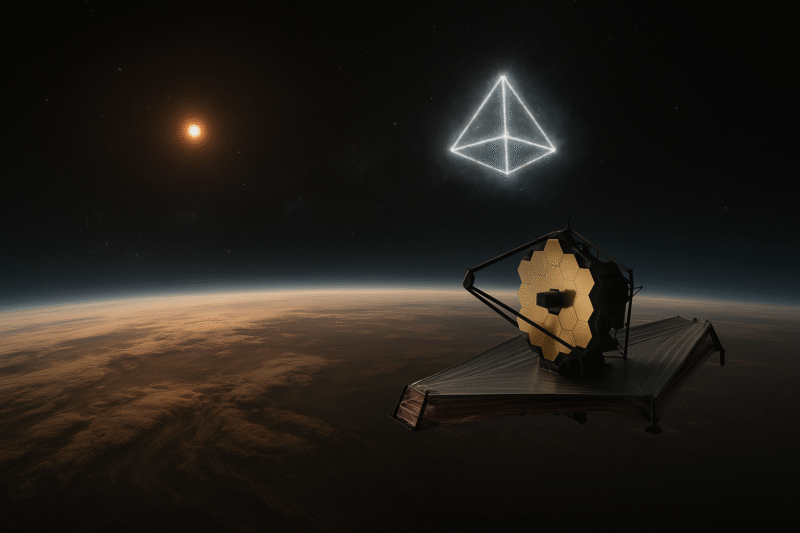







Unveiling the Consciousness Cloud Theory
The Consciousness Cloud Theory proposes that human minds may be interconnected through a collective consciousness, forming a global network that transcends individual awareness. This radical concept suggests consciousness operates similarly to cloud computing, where data is stored and accessed from a shared system beyond the physical brain.
This theory challenges the materialist paradigm that has dominated neuroscience for decades—the assumption that consciousness is solely the product of brain activity. Instead, it posits that our minds may be both individual processors and access points to a broader field of consciousness that exists beyond space and time constraints.1
The Science Behind the Consciousness Cloud
Proponents of the Consciousness Cloud Theory argue that consciousness is not confined to individual neural activity but may exist as a non-local field of information. This idea aligns with theories in quantum mechanics, such as quantum entanglement, where particles separated by vast distances appear to influence each other instantaneously (Penrose & Hameroff, 2014).2
Some researchers suggest that consciousness functions like a distributed system, wherein thoughts, emotions, and memories interact across an invisible mental network. This aligns with the concept of morphic resonance, proposed by biologist Rupert Sheldrake, who theorized that living organisms inherit collective memories and experiences from past generations (Sheldrake, 1981).3
Quantum Foundations of Consciousness
The quantum basis for the Consciousness Cloud Theory draws heavily from the work of physicist David Bohm and his concept of the “implicate order”—a deeper level of reality where separation disappears and everything is interconnected. Bohm proposed that our material world (the “explicate order”) emerges from this underlying field of potentiality.4
Neuroscientist Karl Pribram’s holonomic brain theory complements this view by suggesting that memory and consciousness operate through brain processes similar to holographic principles, where information about the whole is contained in each part. This model provides a possible mechanism for how individual brains might connect to a larger field of consciousness.5
Evidence Supporting the Consciousness Cloud
Emerging research in global consciousness studies offers compelling evidence for this interconnected theory. The Global Consciousness Project (GCP), led by Princeton University, monitors random number generators worldwide. Researchers claim that significant global events, such as 9/11 or natural disasters, correlate with unexplained fluctuations in these devices (Nelson, 2002).6 Such anomalies suggest a collective human response that transcends geographical boundaries.
Additionally, experiments in remote viewing—where individuals claim to perceive distant events or objects using only their minds—have produced statistically significant results, further supporting the idea of consciousness as a shared network (Targ & Puthoff, 1974).7
Synchronicity and Field Consciousness
Swiss psychologist Carl Jung’s concept of synchronicity—meaningful coincidences that cannot be explained by cause and effect—provides another theoretical framework for understanding the Consciousness Cloud. Jung proposed a collective unconscious that connects all humans through shared archetypes and symbols, potentially creating a foundation for non-local consciousness.8
Recent experiments in field consciousness research have explored whether people can influence random events through focused intention. The PEAR (Princeton Engineering Anomalies Research) laboratory found small but statistically significant effects suggesting that human consciousness might interact with physical systems in ways that current science cannot fully explain.9
Implications for Human Connection
If the Consciousness Cloud Theory holds true, it could revolutionize our understanding of empathy, intuition, and collective intelligence. This concept suggests that:
- Intuitive insights may result from tapping into this global mental network, explaining “gut feelings” and sudden inspirations.
- Group meditation and collective intention exercises could influence real-world events through coherent fields of consciousness.
- Emotional connections with loved ones may be more than just psychological; they could reflect real-time information exchange via a shared consciousness field.
- Social movements and cultural shifts might be facilitated by changes in the collective consciousness before manifesting in physical reality.
Telepathy and Collective Awareness
The Consciousness Cloud Theory may provide a framework for understanding phenomena like telepathy and collective awareness. Studies on twins and close family members have documented instances of apparent telepathic communication, particularly during emotionally charged moments.10
Some researchers propose that humanity is developing an emergent collective intelligence—a “global brain” that becomes increasingly coherent as communication technologies advance. This perspective suggests that the internet and social media might be physical manifestations of an underlying consciousness network that has always existed.11
The Consciousness Cloud in Popular Culture
The Consciousness Cloud Theory has gained traction in both scientific circles and popular media. Films like “The Matrix” and “Inception” explore ideas of shared mental spaces, while spiritual traditions have long emphasized concepts resembling a collective consciousness.
Indigenous wisdom traditions worldwide have maintained beliefs in a unified field of consciousness for millennia. These include concepts like the Australian Aboriginal “Dreamtime,” Native American “Great Spirit,” and Hindu “Brahman”—all suggesting an interconnected consciousness that transcends individual experience.12
Modern interpretations of these ancient concepts have emerged in the works of philosophical thinkers like Ken Wilber, whose Integral Theory attempts to synthesize scientific materialism with spiritual understandings of consciousness, proposing a spectrum of awareness from individual to cosmic levels.13
The Future of Consciousness Research
As scientific inquiry into consciousness deepens, researchers are exploring advanced brain imaging, neurofeedback, and quantum theory to uncover whether a global mental network truly exists. The potential discovery of such a phenomenon could revolutionize fields like psychology, neuroscience, and metaphysics.
Measuring Consciousness Fields
Advances in technology are enabling new approaches to measuring potential consciousness fields. Magnetoencephalography (MEG) and quantum sensors are being developed that may detect subtle energy patterns previously unmeasurable by conventional instruments.14
The Human Connectome Project and similar initiatives are mapping the intricate connections within individual brains, potentially providing insights into how these neural networks might interface with larger fields of consciousness.15
Ethical and Philosophical Considerations
The Consciousness Cloud Theory raises profound ethical and philosophical questions. If our minds are indeed interconnected, how does this affect our understanding of privacy, free will, and individual responsibility? Would access to a collective consciousness represent the next stage in human evolution, or would it threaten individuality?16
Philosophers of mind are increasingly engaging with these questions, exploring whether consciousness is fundamental to reality rather than an emergent property of brain activity. This “panpsychist” perspective suggests that consciousness might be a basic feature of the universe, present in some form at all levels of existence.17
Key Takeaways
- The Consciousness Cloud Theory proposes that human minds are linked in a global network, challenging the materialist paradigm.
- Concepts like quantum entanglement, morphic resonance, and global consciousness studies provide scientific grounding for this theory.
- Experiments in remote viewing and collective intention exercises hint at an interconnected mental field.
- Indigenous wisdom traditions and modern philosophical frameworks offer complementary perspectives on collective consciousness.
- Future research may reveal groundbreaking insights about consciousness as a non-local, shared experience.
References
Footnotes
- Dossey, L. (2013). One Mind: How Our Individual Mind Is Part of a Greater Consciousness and Why It Matters. Hay House. Link ↩
- Penrose, R., & Hameroff, S. (2014). Consciousness in the universe: A review of the ‘Orch OR’ theory. Physics of Life Reviews, 11(1), 39-78. Link ↩
- Sheldrake, R. (1981). A New Science of Life: The Hypothesis of Morphic Resonance. Park Street Press. Link ↩
- Bohm, D. (1980). Wholeness and the Implicate Order. Routledge. Link ↩
- Pribram, K. H. (1991). Brain and Perception: Holonomy and Structure in Figural Processing. Lawrence Erlbaum Associates. Link ↩
- Nelson, R. (2002). Coherent consciousness and reduced randomness: Correlations on September 11, 2001. Journal of Scientific Exploration, 16(4), 549-570. Link ↩
- Targ, R., & Puthoff, H. (1974). Information transmission under conditions of sensory shielding. Nature, 251(5476), 602-607. Link ↩
- Jung, C. G. (1960). Synchronicity: An Acausal Connecting Principle. Princeton University Press. Link ↩
- Jahn, R. G., & Dunne, B. J. (2005). The PEAR proposition. Journal of Scientific Exploration, 19(2), 195-245. Link ↩
- Radin, D. (2006). Entangled Minds: Extrasensory Experiences in a Quantum Reality. Paraview Pocket Books. Link ↩
- Heylighen, F., & Lenartowicz, M. (2017). The Global Brain as a model of the future information society: An introduction to the special issue. Technological Forecasting and Social Change, 114, 1-6. Link ↩
- Laszlo, E. (2007). Science and the Akashic Field: An Integral Theory of Everything. Inner Traditions. Link ↩
- Wilber, K. (2000). Integral Psychology: Consciousness, Spirit, Psychology, Therapy. Shambhala. Link ↩
- Hunt, T., & Schooler, J. W. (2019). The easy part of the hard problem: A resonance theory of consciousness. Frontiers in Human Neuroscience, 13, 378. Link ↩
- Van Essen, D. C., et al. (2013). The WU-Minn Human Connectome Project: An overview. NeuroImage, 80, 62-79. Link ↩
- Chalmers, D. J. (1995). Facing up to the problem of consciousness. Journal of Consciousness Studies, 2(3), 200-219. Link ↩
- Goff, P. (2019). Galileo’s Error: Foundations for a New Science of Consciousness. Pantheon. Link ↩