


Former Pentagon insider Matthew Brown has ignited a firestorm with his damning revelations about an elite cover-up surrounding unidentified aerial phenomena (UAPs). Leaked across three recorded interviews with George Knapp and Jeremy Corbell, his claims, centered on a mysterious surveillance initiative known as Immaculate Constellation, have shaken congressional insiders, rattled intelligence circles, and offered the most compelling whistleblower account to date.
Below, we highlight 29 of the most powerful Matthew Brown whistleblower quotes, placing them in full context to reveal the depth of the deception and the stakes Matthew Brown now faces for speaking out.
Table of Contents
Matthew Brown’s Timeline: From Pentagon Insider to UAP Whistleblower
Understanding Matthew Brown’s journey requires examining the critical milestones in his transformation, from a trusted national security professional to one of the most significant UAP whistleblowers in modern history. This timeline contextualizes his actions against unfolding public and classified events.
2017–2018: Pentagon Assignment and Security Clearance
Matthew Brown begins work at the Pentagon under the Department of Defense, specifically within WMD security policy. He holds a TS/SCI (Top Secret / Sensitive Compartmented Information) clearance issued by the DIA.
“It’s a very burdensome role. I thought it was a noble and good mission, I still do.”
2019: Discovery of Immaculate Constellation
While conducting routine access on classified networks, Brown stumbles upon a file titled Immaculate Constellation. It includes satellite imagery, classified incident reports, and detailed descriptions of unexplained craft interacting with military assets.
“The first time I read that, I didn’t know what I had just seen, or if it was even real.”
“It wasn’t just a single video. There were Russian ships, triangle craft, fast movers. It wasn’t a mistake.”
2020: Attempted Internal Reporting and Suppression
Brown follows spillage protocols and brings the issue to his supervisor. Instead of formal procedure, he is told to delete the file and never speak of it again. A second escalation attempt to a SAPCO officer results in mockery and dismissal.
“He laughed at Elizondo’s slide and said it was a joke. Then told me I could go.”
2021–2022: Growing Internal Concern Amid Grusch Developments
With David Grusch’s own efforts to blow the whistle gaining attention, Brown begins to connect anomalies in the intelligence community. He accesses transcripts of Sean Kirkpatrick’s testimony to Senate leaders and is horrified at the misrepresentations.
“Rubio’s words haunted me: ‘What the hell is the Executive Branch doing?’ That line made my blood run cold.”
Early 2023: Coordination With Grusch, Corbell, and Knapp
After a referral from Grusch, Brown initiates communication with journalist Jeremy Corbell and investigative reporter George Knapp. He provides them with his report and supporting documentation. Discussions begin about meeting with Congress.
“This wasn’t about headlines. We were just trying to get the truth into the right hands.”
Mid 2023: Congressional Meetings and Hidden Testimony
Corbell sneaks Brown into Congressional meetings under the radar. Behind closed doors, Brown testifies to select House members while remaining anonymous. His report is later submitted to the Congressional Record without fanfare.
“We hid me in the camera crew. I walked into the building knowing it could end my future.”
Late 2023: Second Hearing Collapse and Executive Interference
Despite the momentum, the second set of UAP hearings are blocked from allowing further whistleblower testimony. Brown is not invited to speak publicly. Nancy Mace misrepresents the report, and the executive branch is accused of censorship.
“They were asking for whistleblowers. And there we are. But they didn’t want to hear it.”
2024: Aftermath and Public Confirmation
Michael Shellenberger publishes the first mainstream confirmation of the report. Brown’s identity begins to leak out. Rather than go quiet, he continues working behind the scenes to support other insiders preparing to come forward.
“If all of us die or are imprisoned, the seeds have been planted. More will come.”
Inside “Immaculate Constellation” The AI Program That Filters Reality
At the center of Matthew Brown’s disclosures is a surveillance initiative called Immaculate Constellation, a program that, according to Brown, functions more like an AI-powered gatekeeper than a traditional intelligence platform.
“It’s a two-faced god, it takes information in, and only lets you hear what you’re cleared to hear.”
A Surveillance Program Hiding in Plain Sight
The system is believed to operate like a self-aware vacuum for reconnaissance data. According to Brown, once raw UAP imagery is detected, from OPIR satellites, ISR aircraft, or even naval radars, it is automatically ingested by the Immaculate Constellation system and fed into another entity known as Sentient, developed by the National Reconnaissance Office (NRO).
These AI models act not only as archivists but as censors. They sanitize footage, excise unexplained elements, and package finished reports that omit any trace of anomalies for lower-clearance operatives.
“These platforms weren’t designed to disseminate truth. They were built to maintain control over perception.”
The Sentient AI – America’s Secret Gatekeeper
Brown confirms Sentient was fully operational prior to 2018, and likely much earlier. Its stated mission is to autonomously detect, prioritize, and exploit satellite intelligence. In practice, it means that UAP footage seen by troops or technicians may vanish before human analysts can flag it.
“You don’t need buildings full of analysts anymore. You just need an algorithm with instructions.”
“A lot of people ask where their UAP footage went. That’s where.”
Compartmentalized Intelligence: A Digital Black Box
Once data enters the Immaculate Constellation system, it becomes compartmentalized. Matthew Brown likens it to a black box, what enters is unknown to most, and what exits is shaped by algorithmic directives rather than transparent oversight.
This filtering ensures even career intelligence officers may never know what surveillance assets have truly captured. UAP encounters recorded by NORAD, USNORTHCOM, or foreign allies might never reach command decision-makers if deemed too disruptive.
“Even within classified systems, there are inner vaults, realities within realities.”
“Digital Amnesia” – The Disappearing Files Phenomenon
Brown describes how multiple insiders noticed UAP-related video files disappearing from databases shortly after being accessed or shared.
“You go back to pull the file, and it’s just gone. Everyone knows, no one talks.”
The consequence is a phenomenon Brown calls digital amnesia, a systemic erasure of anomalous data across U.S. surveillance infrastructure.
Implications for National Security
Matthew Brown warns that by allowing an AI system to dictate what intelligence is real and what is filtered, the U.S. may be inadvertently exposing its forces to unknown threats. Military personnel are left without awareness of anomalies in their airspace, at sea, or near sensitive installations.
“You’re blinding our front lines. You’re making them vulnerable. And you’re doing it in silence.”
As we move forward, these revelations raise uncomfortable questions: Who really controls the data? What else has Sentient filtered out? And how long have we allowed algorithms to define the edges of human understanding?
Scene-by-Scene: Matthew Brown’s Discovery, Suppression, and Ethical Dilemma
What began as a routine late-night review of secure files turned into a career-defining discovery. Matthew Brown, working inside the Pentagon’s intelligence infrastructure, had stumbled upon something extraordinary. It wasn’t labeled “TOP SECRET” or “EYES ONLY,” but it might as well have been.
“I found it 100% by accident. At first, I didn’t know what I was looking at.”
He describes clicking through innocuously named training archives on a classified network. It was there, on a secure but accessible server, that he found the presentation. The title: Immaculate Constellation.
Slide One: An Orb Over the Pacific
The first slide showed a fast-moving orb passing over a classified military installation. It appeared to move independently, exhibiting flight characteristics unknown to current aerospace models. The date was stamped, the platform listed, the location precise.
“I thought it might be a test… but then I kept going.”
Slide Two: A Triangle Above a Russian Vessel
The second image was infrared. A distinct, angular black triangle hovered motionless above a Russian intelligence vessel in the Atlantic. No countermeasures were detected. No recognition or response.
“It wasn’t just the shape. It was the indifference. That ship had no idea what was above it.”
Slide Three: The Saucer in the Clouds
What stopped him cold, though, was the final image, a satellite capture showing what Matthew Brown describes as a “football-field-sized disc” partially obscured by cloud cover. Its outline was unmistakable.
“It moved like it was startled. Like it didn’t want to be seen.”
Matthew Brown couldn’t unsee it. The entire presentation was polished, structured, and seemingly created for internal dissemination. And yet, there were no warnings, no clearance gates, no access flags, nothing to prevent thousands of others from seeing it too.
Internal Reporting: A Wall of Silence
Matthew Brown’s first instinct was to follow protocol. He informed his supervisor, a retired Army colonel, that a spillage had likely occurred. The colonel examined the slides, looked back at Brown, and simply said:
“Delete it.”
And then he left the room.
“We never spoke about it again. But he knew. And I knew. I had just crossed a line.”
Unsettled, Matthew Brown escalated the issue to the SAPCO office. There, behind locked doors, another official reviewed the slides. This time, the reaction was forced laughter.
“He made a joke about Elizondo and said, ‘Somebody’s having fun.’ Then he told me to go.”
The message was clear: this was to disappear.
“I walked out. The file was gone from the server within the hour.”
Matthew Brown: Marked by Knowledge
After two reporting attempts, Matthew Brown realized he had been flagged. The system had noticed. His presence had been logged. But so had the pattern of suppression.
“It’s like a haunted house. Everyone knows it’s there. But if you scream, they pretend they can’t hear you.”
What followed was a year of watching. Monitoring how others reacted. Watching how information moved. Observing how even good people became compliant once they saw the threat wasn’t external, but institutional.
Political Whiplash: How Matthew Brown’s Report Shook Congress and Exposed Deep State Interference
The submission of the Immaculate Constellation report to the Congressional Record wasn’t planned, it was smuggled in. With help from George Knapp, Jeremy Corbell, and later journalist Michael Shellenberger, Matthew Brown’s report made its way into the hands of House members through backchannels, bypassing formal DOD oversight.
“We brought it in physically. There was no other way. The system was built to ignore people like me.”
A Hearing That Never Was
Brown’s report had been poised to trigger one of the most explosive congressional hearings in U.S. history. Whistleblowers had already come forward, David Grusch, Ryan Graves, and others. Brown, however, was different. He had documentation. He had seen classified transcripts. And he was willing to testify.
“They were asking for whistleblowers. And there we are. But they didn’t want to hear it.”
Brown was ready. He had told both Corbell and Congressional staffers: if formally asked, he would testify under oath.
“I made it clear. I didn’t want the spotlight. But I was prepared to speak, if they gave me the chance.”
But the chance never came.
Executive Branch Interference
Leading up to the second round of hearings, there was momentum. House offices were reviewing Brown’s report. Corbell and Knapp had organized meetings with staffers. Brown met covertly with decision-makers in a series of camera-free closed-door briefings.
Then the doors slammed shut.
Representative Tim Burchett later admitted publicly that the hearings were “controlled by the executive branch.” Witnesses were filtered. Topics were neutered. Brown’s name was quietly removed from the internal schedule.
“They knew if I testified, it would become part of history. That’s what they feared.”
A Report Entered Into the Record Without Permission
Though Brown never testified, his report still made it into the Congressional Record. Corbell and Shellenberger coordinated with sympathetic House members to formally submit the report in its entirety.
“They panicked. The unelected staffers who control the gatekeeping didn’t know what hit them.”
Brown describes the reaction as sheer chaos.
“We saw panic. Not from the bosses, but from the minions. Their bosses didn’t tell them this was coming.”
Congressional staffers were blindsided. For the first time, a document they couldn’t suppress had been entered, authored by someone with firsthand knowledge, direct access, and clearances.
“This wasn’t a Pentagon product. This was mine. Every word.”
Public Misrepresentation and Strategic Silencing
Congresswoman Nancy Mace later misrepresented the report on the record, calling it a Pentagon document, an error Brown says wasn’t accidental.
“That wasn’t a mistake. It was damage control.”
Though publicly dismissed, privately the report was being studied and dissected. House members were briefed. National security staff were alerted. The executive branch had been bypassed—and they knew it.
“Once it’s in the record, it’s forever. You can’t erase it. That’s why they’re scared.”
Brown had taken the biggest risk of his life. And yet, he was still anonymous. For now.
“It was a win. A small one. But in this war, you take what you can get.”
Classified Craft Descriptions: The Footage They Never Wanted You to See
Among the most explosive aspects of Matthew Brown’s testimony are the descriptions of craft seen in the Immaculate Constellation archive. These are not mere lights in the sky. Brown provides detailed accounts of multiple vehicle types, each with distinct morphology, behavior, and context, observed by classified platforms across the globe.
The Cloud-Skimming Disc
“It was football-field-sized and hiding in the clouds. Then it darted away, like it knew it had been spotted.”
Captured by a satellite using infrared black-hot imaging, the disc emerged from beneath cloud cover, hovered momentarily, then rapidly exited the frame. Brown recalls its motion as almost startled, suggesting sentient evasion rather than random behavior.
“It looked playful, or alarmed. I remember thinking, this isn’t just tech. This is intelligent.”
The Atlantic Triangle Over a Russian Vessel
“It was angular, black, and smaller than the ship it hovered over. The Russians didn’t even notice it.”
This incident occurred at night, captured by a U.S. platform tailing a Russian intelligence ship. The triangle, unlike others described as equilateral, had a swept-back geometry and matched the vessel’s speed silently above it. No evasive action. No radar locks. No response.
“If it had been a U.S. drone, it would have been acknowledged. This was something else.”
The Cuboid Orb Formation
“They called it a cuboid, but it moved like a swarm. Metallic, self-illuminating, pulsing.”
Matthew Brown described a formation of cuboid orbs near a sensitive coastal installation. The orbs flew in geometric patterns and transitioned effortlessly from inland to sea. Their movements were synchronous, as though guided by a collective awareness rather than central control.
“These weren’t drones. They behaved like a school of fish, fluid, adaptive, alive.”
The Floating Brain: Jellyfish Morphology
“We called it the floating brain. Others called it the jellyfish. Either way, it didn’t belong in our skies.”
Brown had seen visual analogs of the so-called “jellyfish” UAP before the name was made public. Though he never viewed the now-infamous Middle East jellyfish video directly, he had seen similar footage of organic, irregular UAP morphologies labeled in military systems as “floating bio-anomalies.”
“Southcom had one. It crossed the border into U.S. airspace. It looked like it was swimming through clouds.”
Tic Tacs and Boomerangs
In addition to discs, orbs, and triangles, Brown reported brief glimpses and references to the classic “Tic Tac”-shaped UAP as well as craft shaped like boomerangs or manta rays.
“You see the same shapes appear across theaters. It’s like a design library no one talks about.”
Engagements Without Engagements
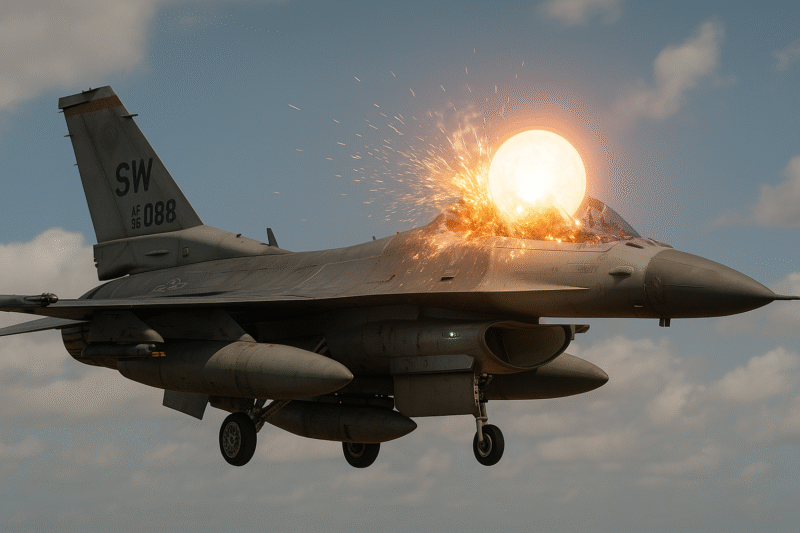
Brown also notes several incidents where U.S. aircraft were actively interacting with UAPs, even engaging them without authorization to fire.
“They boxed in an F-22. Orb formations like a dogfight, but we weren’t the ones flying aggressive.”
In one unclassified incident, a Sidewinder missile reportedly made contact with a UAP, and bounced off.
“It’s as if there’s a field around them. The missile made impact. No damage. Then it was gone.”
These encounters, hidden behind layers of classification and sanitized reports, represent a global pattern of interaction with something not acknowledged by officialdom.
“We’re not just watching them. They’re watching us, and they’re not afraid.”
“We Built a Prison Around Ourselves” – Brown’s Motivations to Speak Out
Matthew Brown’s motivations go far beyond curiosity or professional obligation. What pushed him to break ranks and risk his career, safety, and future was something deeper, a philosophical conviction that secrecy, unchecked, is a societal poison.
“We live in a dream, a constructed reality. Science is distorted. Truth is suppressed.”
For Brown, the suppression of UAP information isn’t just a military concern, it’s an existential threat. He believes humanity is being denied not only access to facts, but access to a higher potential.
“This doesn’t stop. There are more of us. And if we die or are imprisoned, others will come.”
He expresses concern that public institutions are operating in an environment governed not by truth, but by control. His belief is that what we’re allowed to know has been filtered, not for national security, but to maintain an artificial status quo.
“Why is Congress asking for whistleblowers under amnesty for something that ‘doesn’t exist’?”
This cognitive dissonance, between what Congress is told, what insiders know, and what Brown has seen, fuels his mission. The AI systems. The disappearing footage. The frightened staffers. The evasive hearings. They all tell the same story:
Something is here. It has been here. And someone, somewhere, doesn’t want us to know.
“We’re not just dealing with another nation’s tech. We’re dealing with another paradigm.”
In the end, Matthew Brown’s act of whistleblowing is framed less as rebellion and more as redemption. He describes his decision not in defiance, but in duty.
“There’s a window left to correct course. But it’s closing fast. This was my push against the tide.”