





Introduction: Trojan Asteroids Planetary Defense – Our Civilization’s Greatest Safeguard
When astronomers worldwide observed Comet Siding Spring making an alarmingly close approach to Mars on October 19, 2014, passing at just 140,000 kilometers, or one-third the distance from Earth to the Moon, it served as a stark reminder of our solar system’s unpredictable dangers. Had this relatively small 700-meter comet struck Earth instead of harmlessly passing Mars, the consequences would have been catastrophic: a 6.1-mile-wide crater, a 28-gigaton explosion equivalent to a million Hiroshima bombs, and a global firestorm capable of triggering nuclear winter.
Table of Contents
While asteroids receive more attention in popular discussions of cosmic threats, comets represent a uniquely devastating danger to Earth and future human settlements throughout the solar system. Their extreme velocities, typically 50-55 kilometers per second compared to asteroids’ 20-25 km/s, combined with our limited detection capabilities until they’re already approaching the inner solar system, make comets potentially civilization-ending threats that demand innovative defensive strategies.
Recent scientific research, including a groundbreaking Harvard University study, suggests an unexpected solution might lie in Jupiter’s Trojan asteroids, and NASA’s Lucy mission may be providing the first crucial reconnaissance for humanity’s future planetary defense network.
Understanding the Unique Threat of Cometary Impacts
The Velocity Problem
The destructive potential of cosmic impacts isn’t just about size, it’s about speed. Comets typically travel through the solar system at velocities averaging 50-55 kilometers per second, more than twice the speed of most asteroids. This dramatically increases their kinetic energy upon impact, making even relatively smaller comets devastatingly destructive.
A comet the size of Halley’s Comet striking Earth would cause damage significantly exceeding the asteroid impact that ended the dinosaurs’ reign. Historical evidence suggests fragments of Halley’s Comet may have already caused tremendous climatic events throughout human civilization.
The Detection Challenge
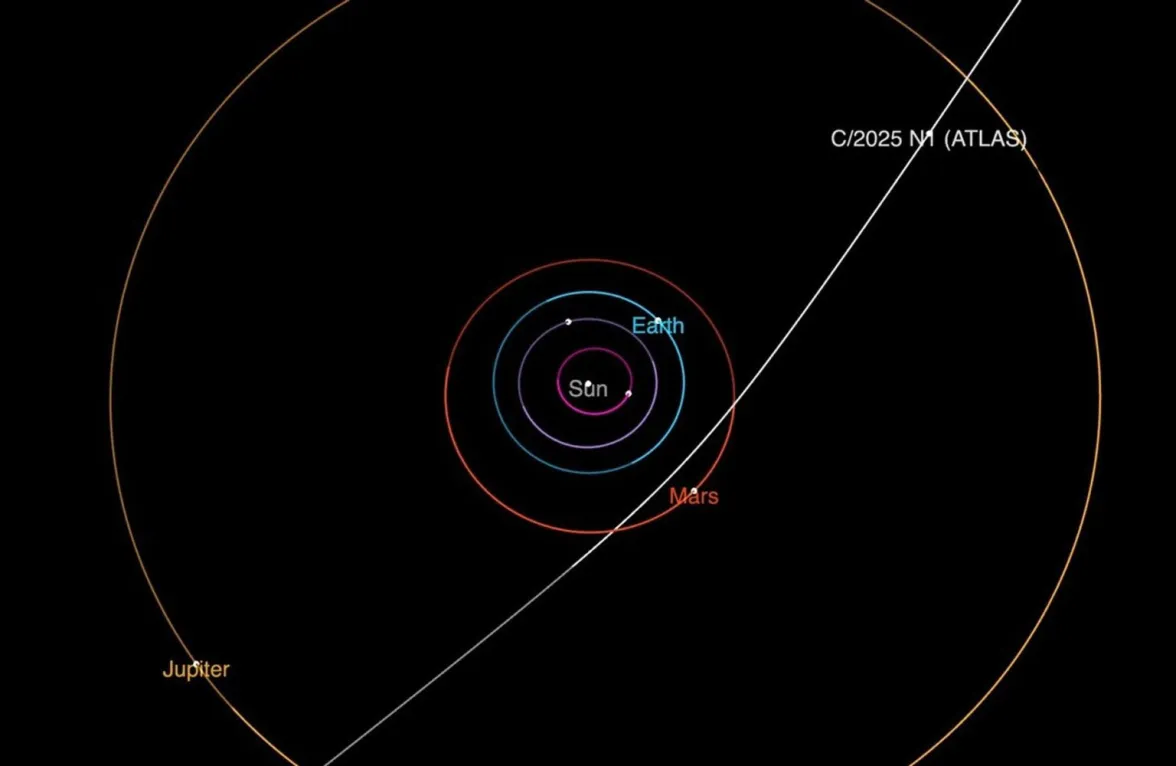
Unlike near-Earth asteroids that orbit predictably in the inner solar system, many comets originate from the distant Oort Cloud, with orbital periods spanning centuries or even millennia. This means we often have no warning of their approach until they’re already within the realm of Jupiter or Saturn, far too late for effective intervention from Earth.
This detection problem represents one of planetary defense’s greatest challenges: how can we protect against threats we can’t see until it’s too late?
Jupiter’s Trojan Asteroids: Nature’s Cosmic Parking Lots
What Are Trojan Asteroids?
Jupiter, our solar system’s massive gas giant, has such immense gravitational influence that it’s created two remarkable groups of asteroids known as the Trojan asteroids. These remnants of our early solar system are trapped in stable orbits associated with, but not particularly close to, Jupiter itself.
The Trojans occupy what scientists call Lagrange points, essentially solar system “parking lots” where Jupiter’s and the Sun’s gravitational forces cancel each other out. Objects that drift into these regions tend to remain stable for billions of years, making them unique cosmic repositories of both scientific knowledge and potentially life-saving resources.
The Lucy Mission: Our First Close Look
Recognizing the scientific importance of these unexplored bodies, NASA launched the Lucy spacecraft in October 2021. Over its groundbreaking 12-year mission, Lucy will explore an unprecedented number of asteroids, including eight Trojan asteroids representing five primary targets and three of their satellites.
Lucy has already encountered two main belt asteroids, Dinkinesh in November 2023 and Donald Johansson in early 2025, providing our first detailed photographs of these distant objects. Beginning August 2027, Lucy will start exploring the Trojans themselves, including Eurybates and its satellite Queta, Polymele and its unnamed satellite, Leucus, Orus, and finally the Patroclus-Menoetius binary asteroid pair.
Composition and Resources: More Than Just Rocks
Early observations suggest the Trojan asteroids may contain substantial water ice resources, with one asteroid even exhibiting comet-like behavior with a visible tail. This presence of ice would make the Trojans natural refueling stations, capable of providing drinking water, breathable oxygen, and rocket fuel for future missions.
The Lucy mission is venturing into unknown territory, as five of its target asteroids are either D-type or P-type asteroids with low albedos (reflectivity) and relatively featureless spectra with steep red slope characteristics. Scientists hypothesize these are rich in organics and volatile elements, but with only one potential D-type meteorite in Earth’s collections (the Tagish Lake meteorite) and no known P-type meteorite samples, our knowledge remains severely limited.
The Harvard Study: Trojan Asteroids Planetary Defense Systems
The Theoretical Foundation
A groundbreaking Harvard University study proposes an innovative Trojan Asteroids Planetary Defense framework that could revolutionize our approach to cosmic threat mitigation. This comprehensive Trojan Asteroids Planetary Defense strategy recommends two complementary approaches:
- Deploying optical telescopes to appropriate Trojan asteroids to observe incoming dangerous objects much earlier than Earth-based systems
- Establishing a permanent space base in the Trojans to host deflection missiles that could intercept dangerous objects while they’re still moving relatively slowly
The Physics of Optimal Interception
The genius of using the Trojans for interception lies in basic orbital mechanics. As objects approach the inner solar system, their sun-centric speed progressively increases, the closer they get to the sun, the faster they move. This means the best time to intercept and deflect a comet is when its velocity is at its lowest, far from the sun.
Interceptions launched from Earth or even Mars would be substantially less effective. By the time such missions reached incoming comets, the threats would already be moving so rapidly that altering their trajectories would be enormously difficult. For large comets like Halley’s, deflection might prove impossible even with advanced technology if attempted too late.
The Patroclus-Menoetius Advantage
Among the Trojan asteroids, the Patroclus-Menoetius binary presents a particularly fascinating potential base location. Both asteroids exceed 100 kilometers in diameter and orbit each other at approximately 600 kilometers distance, creating several unique advantages:
- Space Elevator Potential: The two asteroids could be tethered together with a space elevator, allowing easy transit between them while harvesting resources from both bodies
- Artificial Gravity Generation: Slightly increasing the rotation of the binary system could create natural artificial gravity through centrifugal force
- Central Base Positioning: A spinning base positioned exactly between the two asteroids and connected by space elevators could harvest resources from both while providing artificial gravity
- Enhanced Missile Deployment: The natural centrifugal force of the binary system could provide initial delta-V for interceptor missiles, reducing fuel requirements
The Technical Implementation of a Trojan Defense Base
Early Warning System Architecture
A comprehensive defense system based in the Trojans would likely include a network of telescopes distributed across multiple asteroids to provide 360-degree monitoring of the outer solar system. Advanced AI systems would continuously analyze this data, identifying and tracking potential threats years or even decades before they would become visible to Earth-based systems.
This early warning capability would prove invaluable not just for Earth, but for all human settlements throughout the solar system, including potential colonies on Mars, the Moon, or elsewhere that might otherwise have minimal warning of approaching threats.
Intercept Technologies
Kinetic Impactors
The simplest deflection technology would involve high-mass kinetic impactors, essentially sophisticated battering rams designed to alter a comet’s trajectory through direct collision. The distance advantage provided by a Trojan base would allow these impactors to reach threats while they’re moving relatively slowly, maximizing effectiveness.
Nuclear Options
For larger threats requiring more significant energy transfer, nuclear devices remain the most energy-dense option available. While controversial, having such capabilities positioned in the outer solar system would provide a last resort against civilization-ending impacts.
Gravity Tractors
For slower, more controlled deflections, gravity tractors, spacecraft that hover near an object and use their own gravity to gradually alter its course, might prove effective when deployed with sufficient lead time from a Trojan base.
Resource Utilization and Self-Sustainability
Any permanent base in the Trojans would need to be largely self-sufficient, leveraging the abundant water ice and potentially valuable minerals present in these asteroids. Advanced 3D printing technologies could use in-situ resources to manufacture replacement parts, expansion modules, and even new interceptor vehicles as needed.
The water resources could be electrolyzed to produce hydrogen and oxygen for fuel, life support, and rocket propellant, while carbon from carbonaceous asteroids could contribute to manufacturing processes and potentially even food production through advanced hydroponics.
Timeline for Implementation
Short-Term (Next Decade)
The Lucy mission represents our first exploratory phase, gathering essential data about the composition, structure, and potential resources available in the Trojans. This information will prove invaluable for future mission planning.
Medium-Term (2030s-2040s)
Following Lucy’s findings, dedicated follow-up missions could deploy the first automated telescopes to the Trojans, beginning the early warning network. Robotic resource utilization demonstrations might begin extracting water and testing processing techniques.
Long-Term (2050s-2100)
The establishment of a permanent human presence in the Trojans might become feasible by mid-century, with initial construction of defensive capabilities following. A fully operational defensive network protecting the entire inner solar system could be achievable before the end of the 21st century.
Broader Implications for Solar System Development
Beyond Planetary Defense
While protecting Earth and other settlements from cometary threats provides the primary justification for Trojan development, such facilities would serve multiple additional purposes:
- Scientific Research: A permanent presence in the Trojans would enable unprecedented study of these pristine solar system remnants
- Resource Harvesting: The Trojans’ abundant resources could support both the base itself and broader human expansion
- Gateway to the Outer System: As a natural refueling station, a Trojan base would facilitate exploration and potential development of the outer solar system
- Technological Development: The challenges of establishing such remote bases would drive innovation in automation, robotics, life support, and energy systems
Economic Considerations
Though the initial investment would be substantial, the long-term economic benefits could be considerable. Beyond the incalculable value of protecting civilization from extinction-level impacts, the resources harvested from the Trojans could generate significant economic returns.
Rare metals, water for fuel, and other materials extracted from these asteroids could support both Earth-based industries and expanding space infrastructure, potentially creating an entirely new sector of the economy focused on outer solar system resources.
Technical Challenges and Potential Solutions
Radiation Protection
The Jupiter system experiences significant radiation exposure, requiring robust shielding for both equipment and potential human inhabitants. Water ice from the asteroids themselves could provide effective radiation shielding material, while underground habitats might offer additional protection.
Communication Delays
At distances of approximately 5 AU from Earth, communication delays of 40+ minutes (each way) would make real-time control impossible. Autonomous systems with high-level AI decision-making capabilities would be essential for effective operation, particularly for time-sensitive interception missions.
Long-Duration Human Presence
If humans eventually staff such facilities, addressing the physiological and psychological challenges of extremely remote, long-duration missions would be essential. The artificial gravity solutions described earlier would help mitigate physical degeneration, while carefully designed habitats and virtual connection technologies could address psychological well-being.
The Ethical Dimension of Planetary Defense
Responsibility to Future Generations
The development of robust planetary defense capabilities represents a profound ethical responsibility to future generations. While the probability of civilization-ending impacts within any given century remains relatively low, the consequences are so catastrophic that failing to develop preventative capabilities when technologically feasible would represent a significant moral failure.
International Cooperation Requirements
No single nation could or should unilaterally control such a system. The development of Trojan-based planetary defense would necessitate unprecedented international cooperation, potentially through expanded versions of existing space treaties or entirely new governance frameworks.
This cooperation would need to address not just the construction and operation of such facilities, but also the decision-making protocols for when and how to deploy interception technologies.
The Profound Implications of Becoming a Multi-Planet Species
Expanding Our Cosmic Insurance Policy
As humanity potentially establishes permanent settlements beyond Earth, whether on the Moon, Mars, or elsewhere, the need for comprehensive planetary defense grows even more acute. A Trojan-based system would protect not just Earth but all human settlements in the inner solar system, providing a cosmic insurance policy for our species regardless of where we call home.
Changing Our Relationship with the Cosmos
Throughout human history, we’ve been passive observers of cosmic events, helpless against whatever the universe might throw at us. The development of effective planetary defense capabilities represents a fundamental shift in this relationship, from cosmic victims to cosmic agents capable of ensuring our continued survival.
This transformation may prove as significant philosophically as it is technologically, representing humanity’s first truly effective countermeasure against extinction-level natural disasters.
The Lucy Mission’s Critical Role
While NASA doesn’t explicitly frame the Lucy mission as a precursor to Trojan Asteroids Planetary Defense infrastructure, its comprehensive reconnaissance provides essential data foundational to future Trojan Asteroids Planetary Defense development. The detailed mapping of these asteroids, analysis of their composition, and understanding of their orbital dynamics will all prove invaluable for planning potential Trojan Asteroids Planetary Defense bases and implementation strategies.
Lucy’s findings regarding the water ice content, presence of useful minerals, and structural characteristics of the Trojans will directly inform the feasibility assessments for future planetary defense infrastructure. In many ways, though focused on scientific discovery, Lucy represents the first tentative step toward a solar-system-wide protective network.
Technical Glossary
- Albedo: A measure of how reflective an object is, with higher values indicating greater reflectivity
- Centrifugal Force: An apparent force that acts outward on an object moving around a center, caused by inertia
- Delta-V: A change in velocity, used as a measure of the energy needed for space maneuvers
- Kinetic Energy: The energy possessed by an object due to its motion, calculated as 1/2 × mass × velocity²
- Lagrange Points: Positions in space where the gravitational forces of two large bodies (like the Sun and Jupiter) produce enhanced regions of attraction and repulsion that can hold a small object steady
- Nuclear Winter: A severe and prolonged global climate cooling effect hypothesized to occur after widespread firestorms following a nuclear war or large cosmic impact
- Oort Cloud: A theoretical cloud of predominantly icy planetesimals believed to surround the Sun at distances ranging from 2,000 to 100,000 AU
- Space Elevator: A theoretical transportation system designed to move objects from a planetary surface into space without using rockets
- Sun-centric Speed: The velocity of an object relative to the Sun, which increases as objects move closer to the Sun
- Trojan Asteroids: Asteroids that share an orbit with a planet or larger moon, clustered around two special points (Lagrange points) along the orbit
Timeline of Key Developments in Planetary Defense
- 1908: Tunguska event in Siberia demonstrates destructive potential of even relatively small cosmic impacts
- 1980: Luis Alvarez and colleagues publish evidence that an asteroid impact caused the dinosaur extinction
- 1994: Comet Shoemaker-Levy 9 impacts Jupiter, providing first modern observation of a major planetary impact
- 1998: NASA establishes Near-Earth Object Program (now CNEOS) to catalog potential impact threats
- 2005: U.S. Congress directs NASA to detect 90% of large NEOs (>140m) by 2020 (still incomplete)
- 2013: Chelyabinsk meteor explodes over Russia, injuring 1,500+ people, renewing interest in planetary defense
- 2014: Comet Siding Spring passes within 140,000 km of Mars, highlighting threat to future colonies
- 2021: NASA launches Lucy mission to explore Jupiter’s Trojan asteroids
- 2022: NASA’s DART mission successfully demonstrates asteroid deflection technology
- 2022-2025: Harvard research proposes comprehensive Trojan Asteroids Planetary Defense framework
- 2027-2033: Lucy mission explores eight Trojan asteroids, providing critical data for Trojan Asteroids Planetary Defense planning
- 2030s (projected): First dedicated Trojan Asteroids Planetary Defense telescopes potentially deployed
- 2050s (projected): Potential establishment of first robotic Trojan Asteroids Planetary Defense capabilities
- Late 21st Century (projected): Potential completion of comprehensive Trojan Asteroids Planetary Defense network
Frequently Asked Questions
Why are comets more dangerous than asteroids?
Comets typically travel at much higher velocities (50-55 km/s) than asteroids (20-25 km/s), which dramatically increases their destructive potential upon impact. Additionally, we often have less warning time for comets entering the inner solar system.
How common are potential civilization-ending impacts?
Large, civilization-threatening impacts are extremely rare, occurring on timescales of millions of years. However, smaller impacts capable of regional devastation occur more frequently, and the random nature of these events means they could happen at any time.
Could we defend against a large comet with current technology?
With current technology deployed from Earth, defending against a large comet would be extremely difficult or impossible, particularly if detected late in its approach. The extreme velocities of comets by the time they reach the inner solar system make deflection exceptionally challenging.
What is the Lucy mission discovering about Trojan asteroids?
The Lucy mission is providing our first detailed observations of these distant objects, including their composition, surface features, and potential resources. Early findings suggest the presence of water ice and potentially valuable organic compounds.
How much would a Trojan asteroid defense system cost?
While no official estimates exist for such a forward-looking project, the development of a comprehensive Trojan-based defense system would likely cost hundreds of billions of dollars over several decades, comparable to other major space infrastructure projects like the International Space Station.
When might a Trojan Asteroids Planetary Defense system become operational?
Given current technological trajectories and assuming continued international cooperation in space development, initial elements of a Trojan Asteroids Planetary Defense system might be deployed by the 2050s, with a comprehensive Trojan Asteroids Planetary Defense network potentially operational before the end of the 21st century.
Would such bases be inhabited by humans or run by robots?
Initial development would almost certainly rely on robotic systems, with potential human presence following only after reliable life support and radiation protection systems were established. A hybrid approach with limited human presence supported by extensive automation seems most practical.
How would we communicate with bases so far from Earth?
At distances of approximately 5 AU, one-way communication would take around 40 minutes. High-bandwidth laser communication systems would likely be employed, with substantial local AI autonomy to handle time-sensitive operations.
Could private companies be involved in developing Trojan bases?
While initial exploration and development would likely be led by government space agencies, private companies could eventually play significant roles in resource utilization, transportation infrastructure, and potentially even defense system operation through public-private partnerships.
Beyond defense, what scientific benefits would Trojan bases provide?
Permanent facilities in the Trojans would enable unprecedented study of these pristine solar system remnants, potentially revealing crucial information about solar system formation, the origins of Earth’s water, and the distribution of organic compounds throughout our cosmic neighborhood.
Conclusion: The Future of Trojan Asteroids Planetary Defense
The Trojan asteroids, these distant, unexplored remnants of our solar system’s formation, represent the cornerstone of future Trojan Asteroids Planetary Defense initiatives. By establishing advanced Trojan Asteroids Planetary Defense bases in these natural cosmic parking lots, we could create an unprecedented protective network guarding Earth and the inner solar system from civilization-ending impacts.
Such bases would serve multiple functions beyond defensive capabilities, providing resources for further space development, enabling scientific discoveries, and potentially serving as gateways to the outer solar system. The Lucy mission, while primarily scientific in nature, may be recognized by future generations as the foundational first step in establishing a comprehensive Trojan Asteroids Planetary Defense network that could ultimately save our civilization.
As we continue expanding into the solar system, the wisdom of establishing such forward bases becomes increasingly apparent. The Trojan asteroids offer not just scientific curiosity but a potential shield against cosmic threats, sentinels standing guard over not just our home planet, but all future human settlements throughout the inner solar system.
Through innovative thinking and long-term planning, what seems like science fiction today may become essential infrastructure by the end of this century, a testament to humanity’s capacity to protect itself against even the most extreme threats our universe can present.
Recommended Meta Description:
Explore comprehensive Trojan Asteroids Planetary Defense strategies that could safeguard Earth from civilization-ending comets. Learn how NASA’s Lucy mission is pioneering Trojan Asteroids Planetary Defense systems capable of protecting our entire solar system from devastating cosmic impacts. The definitive guide to humanity’s future cosmic shield.